

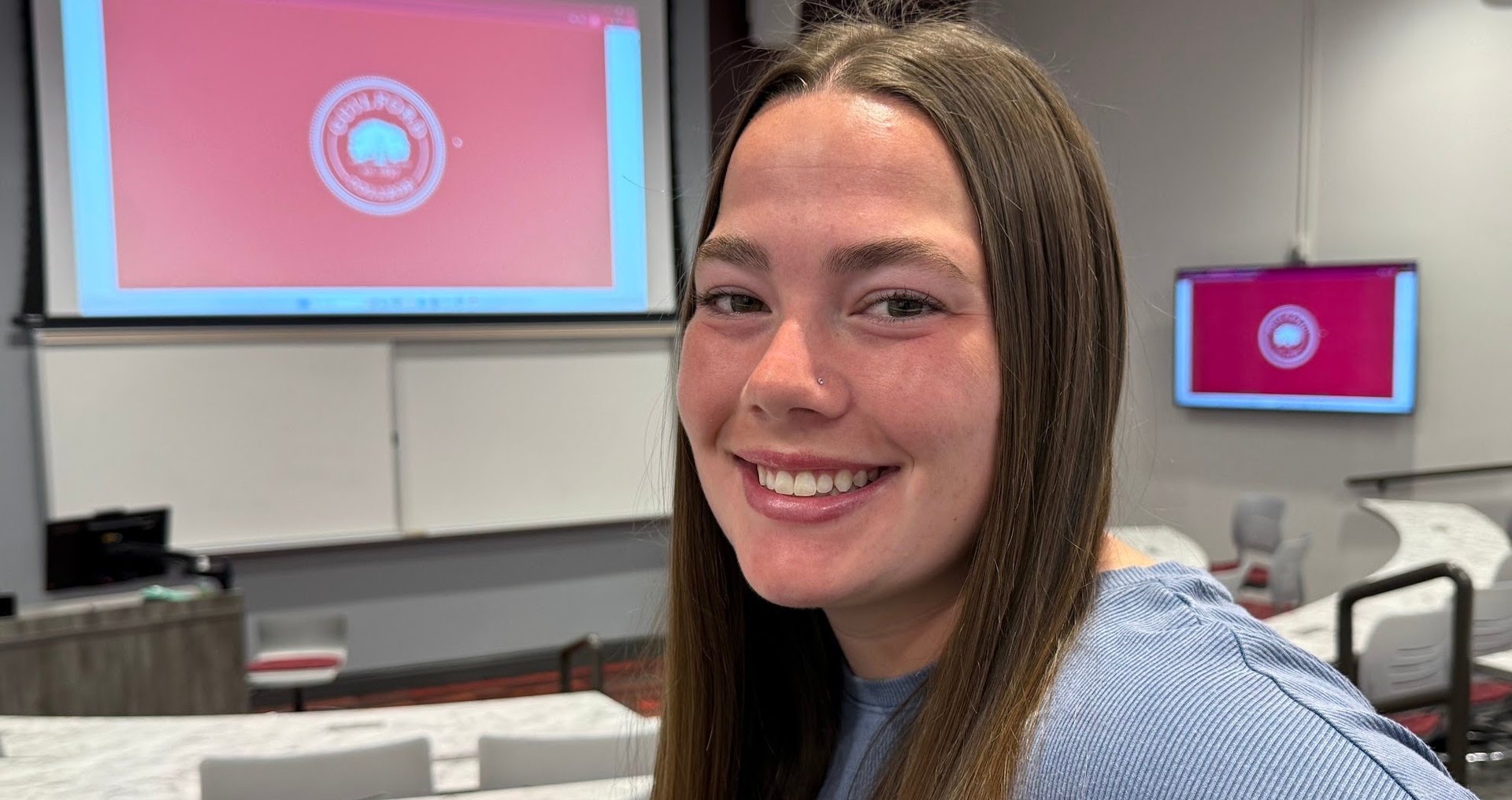
From early visits to campus to late nights studying bloodstain patterns, Shiloh Gray ’25, ’26 MCJ followed a quiet instinct that Guilford — and forensic science— were exactly where she belonged.
“I want to be able to find closure for families.”
The first time Shiloh Gray ’25, ’26 MCJ stepped onto campus, she was in eighth grade, wearing softball cleats and thinking more about line drives than blood spatter and crime scenes. She came for a softball camp in the fall, when the trees were showing off and the light through the leaves made the place feel almost cinematic. She remembers walking from the softball field to a Homecoming football game and being stopped four or five times by people she didn’t know offering more than friendly nods.
Hello.
Why are you at Guilford?
You’ll love it here.
At 13, you don’t catalog those moments as life-defining. But they have a way of sticking.
By the time she was 16, Shiloh was back at Guilford for a weeklong camp, staying on campus, building friendships that stretched beyond county lines and travel ball. When it came time to apply to college, Shiloh didn’t create a spreadsheet. She didn’t visit a dozen campuses. Who needs spreadsheets or tours when you know what you want?
“Guilford was the only place I applied,” she says, and laughs a little at the audacity of her younger self.
Why? Because it felt like home. Not in the cliché way. In the 45-minutes-from-Davidson-County-so-my-parents-can-take-me-to-dinner way. In the people-who-stop-you-on-the-sidewalk way. In the small, unassuming campus without massive buildings trying to command your attention.
These days, Shiloh is likely the one stopping on the sidewalk to welcome others.
Shiloh is a Criminal Justice and Forensic Biology double major who is now pursuing her master’s in Criminal Justice at Guilford and working as a Presidential Fellow at the College.
She has become the person she once encountered as a middle schooler with a glove over her shoulder. She smiles at campus tours. She’s an All-Conference, two-way player and a top pitcher and hitter who sits in with softball recruits at her coach’s request. As a Presidential Fellow, she’s learned to speak up, lean in, and look outward.
That’s no small thing for someone who calls herself an introvert.
“I’ve never been a social person,” she says. “Freshman and sophomore year, I still wasn’t.”
College, Guilford in particular, has a way of nudging you, she says. You can’t only orbit the same circle forever. So she started small. A smile. A “Hey, how are you?” Conversations beyond softball. It wasn’t a personality transplant. It was growth.
And growth, as it turns out, is also what draws her to the meticulous world of forensic investigation.
She knew in high school that something about the science of crime scenes pulled at her curiosity. A biomedical technology class. A unit on fingerprinting. Bloodstain pattern analysis. The physics of it all — the arcs and drops and cast-off patterns that tell a silent story. At Guilford, she tested that interest in her first year, enrolling in an introductory forensic biology class.
The first class confirmed it. No hesitation.
What hooked her wasn’t the television-drama version of forensics. It was the hands-on work. Trips to a Greensboro gun range, where students fired weapons and then returned to the lab to examine bullet markings. Hours spent studying fingerprinting techniques. Bloodstain pattern analysis — drop patterns from a blade carried at someone’s side, cast-off arcs from a swinging object — each requiring measurements, angles, patience. A lot of physics, she admits with a grin.
There’s also the crime scene house. Mock grave excavations. Labs that demand precision and composure. It’s one thing to learn terminology. It’s another to stand in a staged scene and understand the weight of what you’re practicing for.
“I want to be able to find closure for families,” she says. That’s the through line. Not the spectacle. Not the lab equipment. The people.
Ask her if Guilford prepared her, and she doesn’t hesitate.
Absolutely.
Not just because she can diagram a blood spatter or analyze a bullet’s markings. But because she understands the temperament required: careful, steady, empathetic. The kind of person who can walk into a room marked by loss and do the work thoroughly, respectfully, without ego.
“I’m ready for whatever comes next for me,” she says. “Guilford played a pretty big role in that.”
Want to learn how Guilford can prepare your for your passion? Contact Steve Mencarini.