

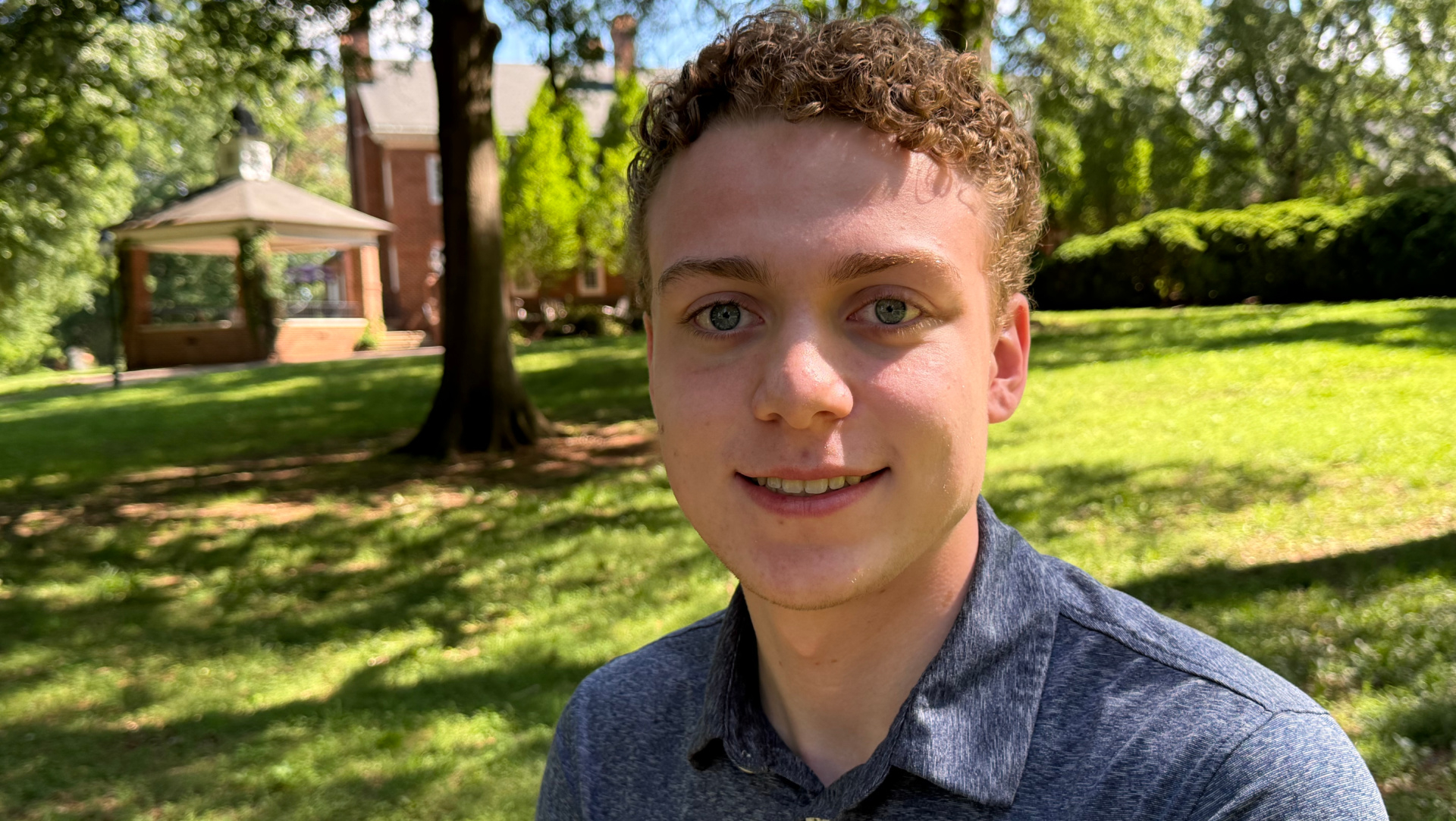
A decade of competitive swimming prepared Keegan Fullagar for Division I athletics. Guilford prepared him for something bigger.
“I think (some students) chase a bit of the rank and prestige of bigger schools when there’s a school like Guilford that offers opportunities those bigger schools just can’t match.”
For years, the rhythm of Keegan Fullagar’s ’28 life began before dawn.
The alarm at 4 a.m. The long practices. The endless black line at the bottom of the pool.
By the time he was 18, Keegan had spent more than a decade swimming competitively, logging the kind of hours that quietly shape a person’s identity long before adulthood arrives. College swimming was never really a question. It was the plan. The assumption. The next lane in the water.
Universities called. Coaches recruited him. Scholarships surfaced.
And then, in a decision that surprised some of his Early College of Guilford classmates and disappointed even more Division I coaches, Keegan chose a different swim lane all together.
This fall, he’ll continue his education at Guilford College, turning down the traditional four-year college path in favor of something that, to him, began to feel increasingly rare: a place where he felt known.
“If other people were surprised I was just as surprised as them,” he says. “But the more I looked into it, the more Guilford made sense in so many ways.”
At first, Guilford was an afterthought in Keegan’s college search.
Like many students, Keegan and his family assumed the cost of a private college would place it out of reach. Then came the College’s Nathan Hunt Scholarship. Then additional fellowship opportunities. Suddenly, a school that once seemed financially impossible became affordable — and even more than that, practical.
Keegan, who wants to be a surgeon, realized he could complete two degrees – Sport Studies and Health Science – in two years while preparing for medical school, all without the burden of overwhelming debt.
“At what point do you sacrifice the swimming aspect for something that’s life changing?” he says.
The question lingered.
So did something else.
Students at the Early College of Guilford, one of the nation’s most prestigious high schools for academics, spend their last two years as high school students taking college classes at Guilford. Over the past two years Keegan had quietly built an academic life. He found professors who knew him well enough to challenge him. Small classes where conversation mattered. A campus environment that felt less transactional and more personal.
“I feel like it’s almost like a family here,” says Keegan, who will be part of the Guilford College Honors Program in the fall.
He still remembers the first sport science course he took with Brenda Swearingin, Professor of Sport Studies. Keegan and Brenda, who swam competitively herself at the University of Arkansas, immediately connected.
“When I tell you day one we hit it off, day one we hit it off,” he says. “Swimming sure, but I loved all of her classes.”
What Keegan found inside Brenda’s and other Guilford classrooms changed how he thought about learning itself.
At Guilford, students do more than listen to lectures. They move. Test. Measure. Apply concepts in real time. Keegan remembers one course focused on physical fitness evaluation where students practiced assessment techniques on one another, learning not only how the science works but why it matters for different populations and bodies.
“There’s always some practical element you can take away from a class each week,” he says.
Even swimming began to look different to him.
A biomechanics course reshaped the way he thought about movement, training and injury prevention. He started reconsidering everything from warmups to long-term athletic health. Increasingly, he says, he began imagining himself less as a swimmer in a lane and more as a mentor standing beside it.
“I’d rather coach the next generation than continue,” he says.
That perspective surprised some classmates at the Early College, where students often chase the prestige attached to nationally known universities. Keegan understands that instinct. But he also believes something gets lost in the process.
“I think (some students) chase a bit of the rank and prestige of bigger schools when there’s a school like Guilford that offers opportunities those bigger schools just can’t match.”
For Keegan, Guilford ultimately became more than a college decision.
It became an answer to a quieter question many students wrestle with but rarely say aloud: What kind of place actually helps a person become who they want to be?
At larger universities, he hears stories from students who barely know their professors’ names.
“To me, that’s crazy,” he says.
At Guilford, he says, the relationships feel different. Professors know when students are struggling. Classmates know one another. Learning asks students not simply to memorize information but to engage with it — and with each other.
Somewhere along the way, the school he never expected to choose became the one place that felt hardest to leave. “It’s weird because I just spent four years on campus as a high school student,” he says. “Now I can’t wait to come back in August.”