

Nick Opie ’26 found room to combine computer science, faith, and ethics because Guilford professors insisted he could do all three.
"That’s every Guilford professor I’ve had — they’re invested in the process, not just the grade."
Nick Opie ’26 did not set out to build a digital hymnal for the age of artificial intelligence. He set out not to fail his operating systems class.
That’s the honest beginning of the story, and it tells you a lot about how Guilford works on him. Operating Systems 321 carries a final project that doesn’t bluff. It counts for most of the grade, demands sustained effort, and punishes procrastination. Nick knew that early, so he started building in August, well before deadline panic set in.
“I wanted something unique,” Nick says. “This was a make-or-break assignment, and I knew I had to care about it to actually do it well.”
Care is the throughline. Nick graduates this spring as a double major in Computer Science and Religious Studies, a pairing that often draws raised eyebrows. For him, the combination makes sense because Guilford never asked him to flatten one interest to serve the other. Faculty encouraged him to stretch instead.
What he built became an AI-powered Christian music generator — lyrics inspired by Bible verses, original music composed locally on his laptop, and cover art generated to match the tone of each piece. It’s not a chatbot writing a few reverent lines. The system actually composes music, a distinction Nick is careful to make.
Part of the project relies on an open-source AI music generator that runs locally rather than on a corporate server. That detail mattered to him. “You actually own what you create,” he says. “It might not be perfect, but it’s yours.”
The idea sharpened through conversations with Chafic Bou-Saba, Professor for Computing Technology and Information Systems, whose guidance helped Nick translate curiosity into structure.
“Chafic never tells you what your project has to be,” Nick says. “He asks questions until you figure out what you’re actually trying to build. He wants you to succeed, but he wants you to understand why it works. That’s every Guilford professor I’ve had — they’re invested in the process, not just the grade.”
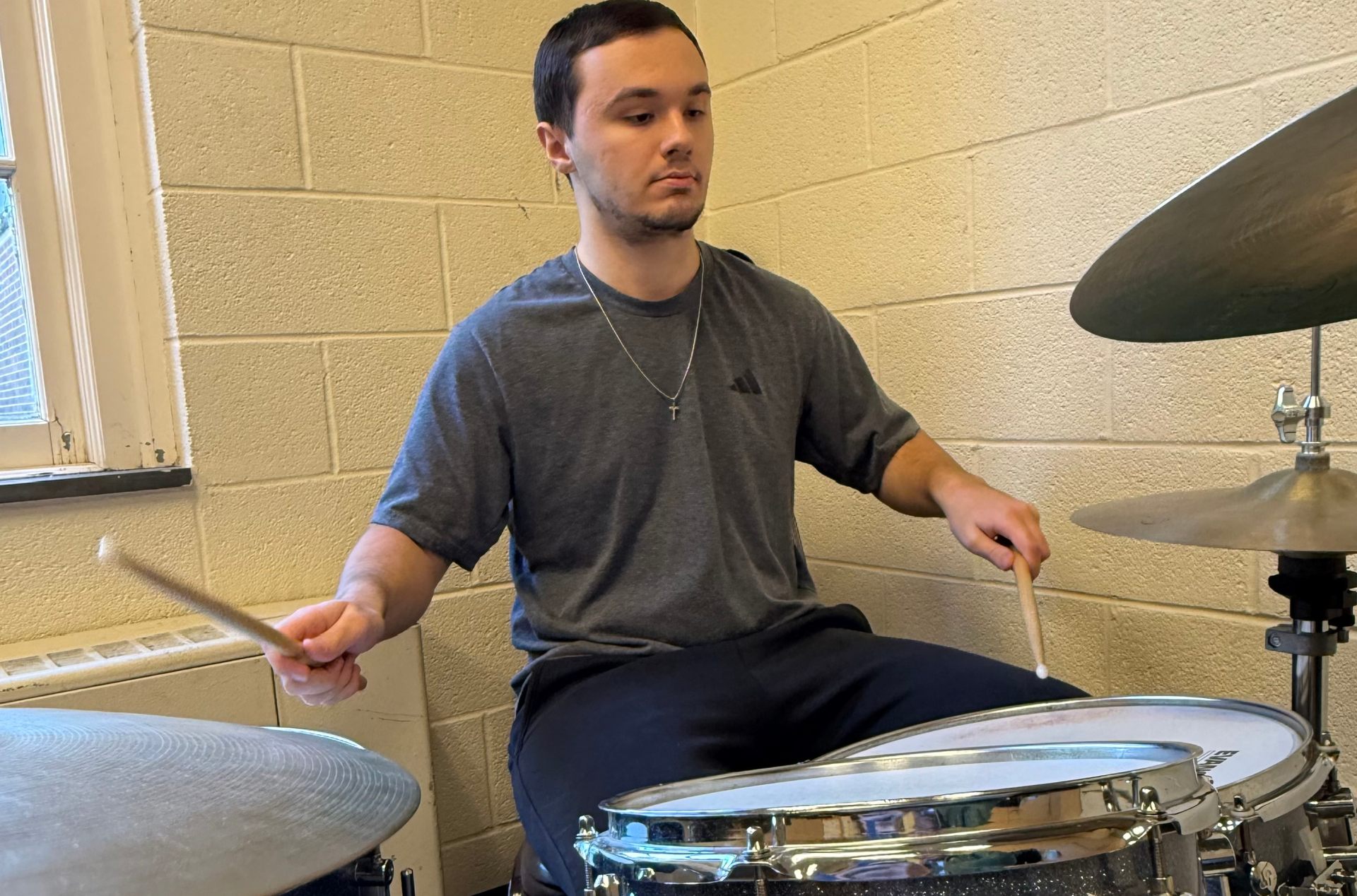
Nick personalized the concept by grounding it in Christian music, a space he knows well. He played drums in Guilford’s jazz ensemble for three years and is active in Cru, the campus Christian organization. His Religious Studies courses didn’t dilute his faith; they complicated it in ways he found necessary.
He speaks especially warmly about Jill Peterfeso, Eli Franklin Craven and Minnie Phipps Craven Professor of Religious Studies, who taught a three-week Title IX course that reshaped how he understands institutional power and lived experience.
“Professor Peterfeso doesn’t let you stay comfortable,” Nick says. “She creates a space where you’re challenged, but not shut down. You leave her class able to talk about hard things with empathy and evidence. That changed how I think — not just academically, but as a person.”
That intellectual posture shows up in how Nick talks about AI. He doesn’t dismiss concerns from artists; he understands them. If technology copies a real person’s voice or likeness, he sees that as a real ethical problem. His project avoids that by design. It’s not imitation; it’s interpretation.
Nick isn’t trying to replace musicians, monetize the project, or turn it into a startup. By the end, the work nearly broke him — late nights, broken code, tools undoing fixes as fast as he made them.
“When I finally submitted it, I thought, ‘That was awesome,’” he says, laughing. “‘I never want to see it again.’”
After graduation, Nick plans to stay in Greensboro and work in IT, a choice shaped by his internship at Guilford’s help desk. There, he’s learned how patience and competence can quietly change someone’s day.
“That’s kind of how I think about faith,” he says. “Do the work well. Be kind. That actually stands out.”
At Guilford, Nick learned how to do both — because his professors insisted he could.