

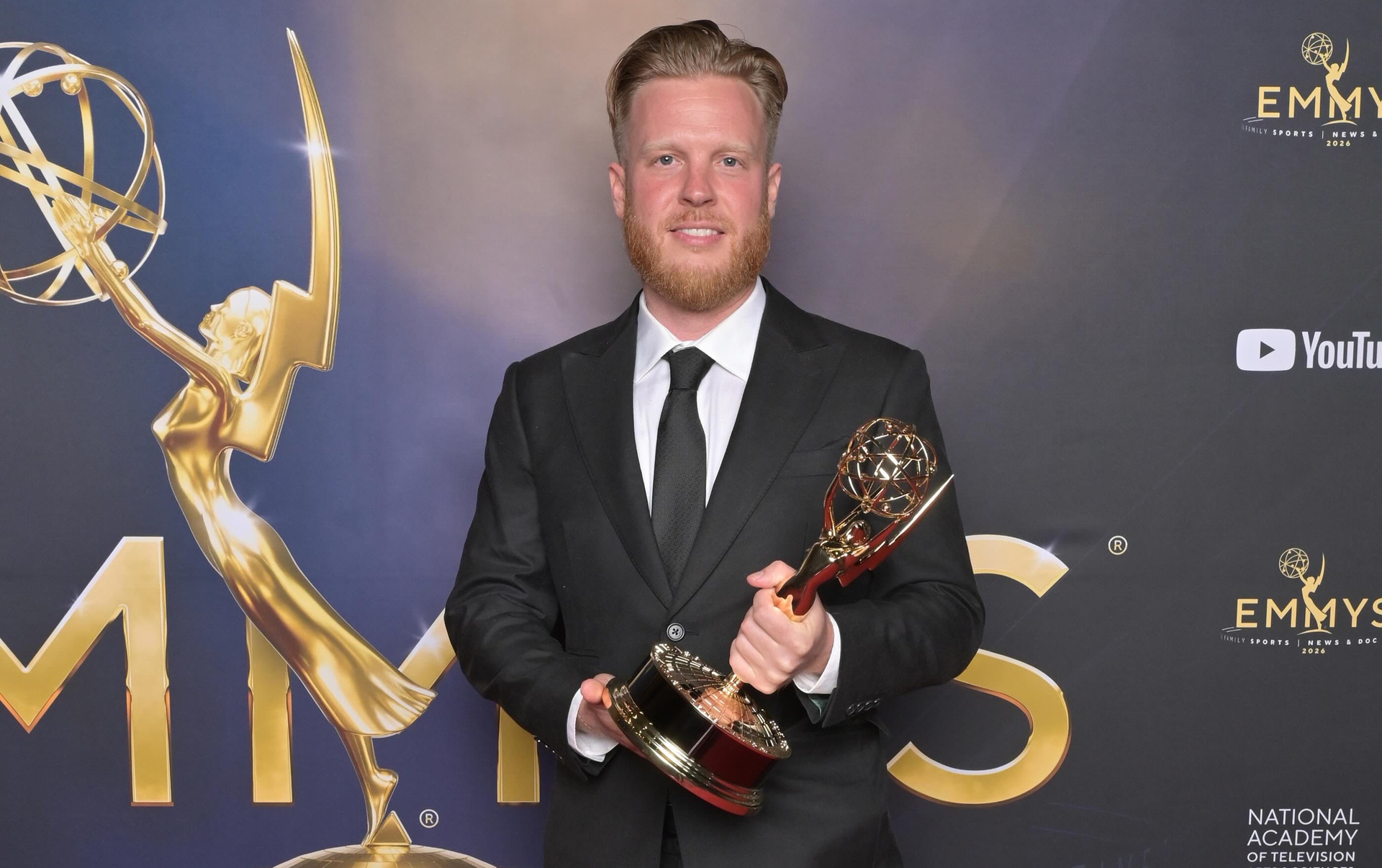
Tom Clement's documentary, "Projecting Protest", recently earned him an Emmy.
That’s the question at the center of Tom Clement’s '14 work — from Guilford classrooms to an Emmy-winning film about protest in the digital age.
“It gives me more conviction that I should listen to my gut and pursue the ideas that I think are interesting and worthwhile. It gives me confidence in my own tastes.”
Ten years ago, Tom Clement ’14 was a production assistant hoping to break into documentary filmmaking. This spring, he stood on a stage in New York City accepting a National Emmy. The path between those two moments wasn’t straight, predictable or particularly easy. It wound through newsrooms, film festivals, early-morning White House assignments and countless hours spent editing footage when most people would have been asleep.
It also began, in many ways, at Guilford.
Tom won the Emmy for Outstanding Short Documentary for “Projecting Protest,” a 22-minute film that explores how activists use light projections to transform buildings into temporary billboards for political messages. The documentary examines a tactic used by groups across the ideological spectrum, from progressive activists protesting economic inequality to white nationalist organizations spreading hate.
For Tom, the project began the way many of his stories do: with curiosity. While covering a Senate debate in Pennsylvania as a video journalist, he noticed a message projected onto a nearby building.
Tax the ultra rich.
The projection lasted only a short time, but it captured his attention. “I just thought it was fascinating,” Tom says.
Most journalists would have treated the projection as an interesting moment in a larger story. Tom wanted to know more. Who was behind it? How did it work? Why was it so effective?
Those questions eventually became a documentary.
“Light projection as a protest tactic is a uniquely impactful tool for dissent,” Tom says. “Anyone with the right technology can make a splash, disrupt powerful organizations using the facade of a building.”
The finished film explores something larger than the technology itself. It asks who gets heard in modern society and what happens when ordinary people discover a way to command attention.
“Following all different kinds of people using the same tactic is what what makes this story so interesting to me,” Tom says. “The ability to project a message means almost any message – good or bad – can be put out there.”
The documentary earned critical acclaim, premiering at DOC NYC, one of the nation’s leading documentary film festivals. Still, Tom didn’t expect to hear his name called at the Emmy Awards.
“I was definitely surprised,” he says. “I was not expecting to win. I was shocked, and I was elated.”
He remembers sitting among teams that seemed much larger than his own. “When they announced the category, every team was cheering,” he says. “It sounded like there were 15 people on each team.”
Then came the announcement. “I basically just said, ‘Oh, (expletive),’ stood up and walked to the stage,” he says with a laugh. “It’s remarkable. It’s such an honor.”
The win carried special meaning because of everything that came before it. In late 2024, Tom was among the journalists laid off during downsizing at Scripps News. Around the same time, “Projecting Protest” premiered at Doc NYC.
For months, he didn’t know whether the film would ultimately air nationally, a requirement for Emmy consideration. The uncertainty could have ended the project’s awards run before it began. Instead, the documentary eventually aired and qualified for national competition.
A jolt of confidence
Today, Tom works as a freelance cinematographer and filmmaker, producing documentaries and documentary-style content for advocacy groups, labor organizations and other clients. The move has brought new challenges, but also new freedom.
“It gives me more conviction that I should listen to my gut and pursue the ideas that I think are interesting and worthwhile,” he says. “It gives me confidence in my own tastes.”
That confidence can be traced back to Guilford. As a student, Tom served as a video editor for The Guilfordian and began developing the skills that would define his career. He credits professors like the late Jeff Jeske and retired Economics professor Robert G. Williams with helping shape his thinking about storytelling, ethics and the role journalism can play in society.
More importantly, Guilford helped him discover the kinds of stories he wanted to tell. One of his first documentaries, “Swine Country,” examined industrial hog farming in eastern North Carolina and its impact on nearby communities.
“The neighbors of these farms basically get sprayed with fecal mist routinely,” he says. “They’ve been speaking out about it for a long time, but their concerns have not really been addressed.”
The subject matter was different, but the instinct was familiar. Tom has always been drawn to stories about people confronting larger systems — individuals trying to be heard by institutions that may not be listening.
“The power of observing people righteously standing up to power,” he says. “That’s always been a part of me. I want to help them tell their story.”
His Quaker upbringing reinforced those values. So did his years at Guilford. “People looking out for each other,” he says. “When you see something that’s wrong, you do something about it.”
Listening to Tom talk about his work, a pattern emerges. Whether he’s documenting environmental concerns in eastern North Carolina, activists projecting messages onto skyscrapers or men searching for belonging in a changing culture, he is ultimately interested in people trying to make themselves heard.
That theme continues in his newest project, a documentary exploring masculinity through a community of male dancers. The film examines friendship, vulnerability and the search for connection among men. The subject is different. The questions are familiar. Who belongs? Who has a voice? How do people find the courage to use it?
The Emmy sitting on Tom’s shelf offers one answer. It is recognition from peers that his work matters. But the award itself feels less significant than the path that led there. A curious student at Guilford picked up a camera and started asking questions. A decade later, Tom is still asking them. Only now, the rest of the country is paying attention.