

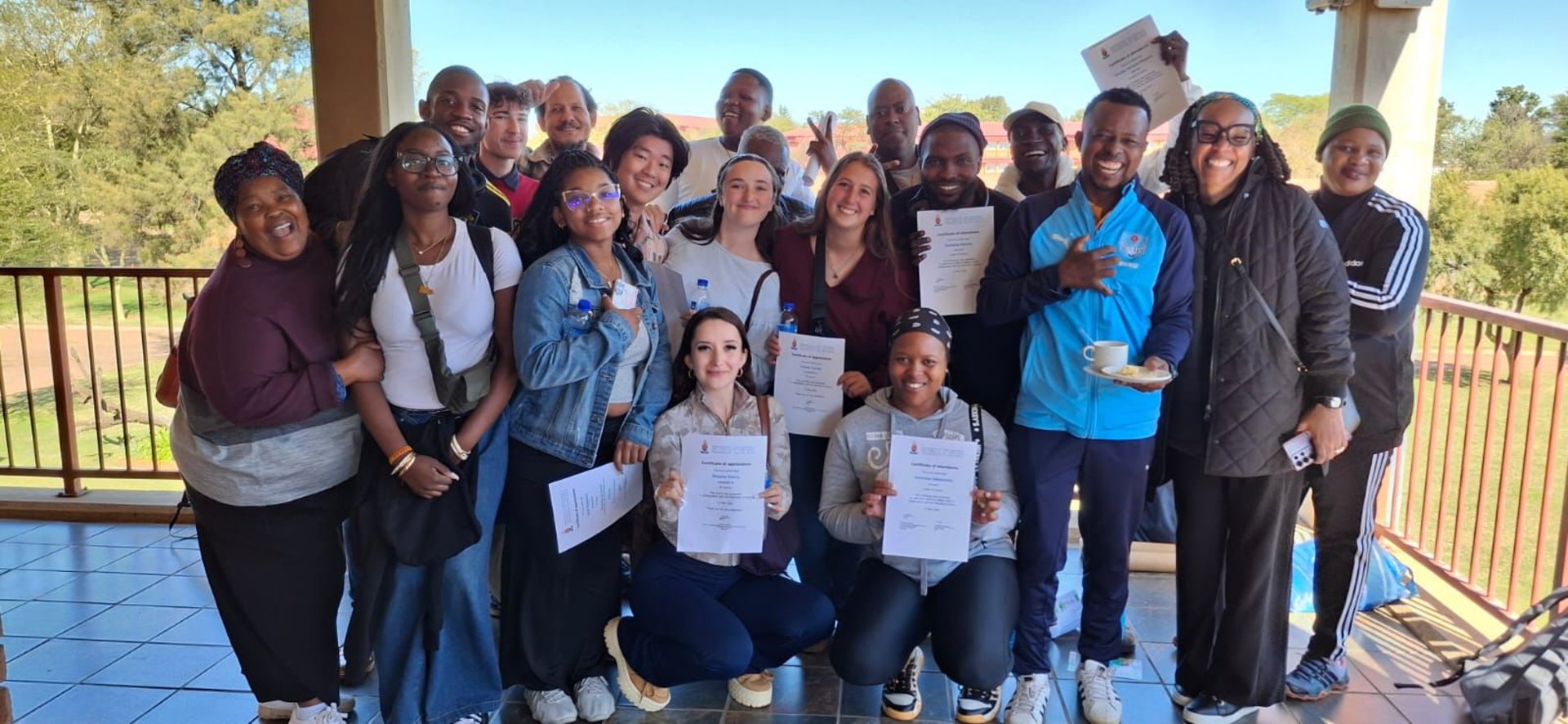
The immersive study abroad experience offered lessons in accountability, humanity and the power of seeing another culture firsthand.
“You never know what’s out there until you go out there and see everything."
The first thing the Guilford students noticed about South Africa was the sky.
Not the famous mountains rising above Cape Town or the oceans colliding at the continent’s edge. Not even the long and difficult history they spent weeks studying before boarding a plane for a three-week study abroad class.
It was the sky. Wide enough to make students like Destini Nyorkor ’26 feel small. Wide enough to make them reconsider what they thought they knew.
“There’s always something in your imagination about a country,” says Destini, still sounding slightly stunned by it all. “But being here feels like a privilege.”
Destini was one of a handful of Guilford students who traveled to South Africa with Meredeth Summers, Guilford’s Chief of Staff, this month for an immersive study abroad experience examining education, culture and the lingering aftershocks of apartheid.
Students say the trip changed them in ways harder to explain than summarize on a syllabus.
For Areli Patterson ’26, the transformation arrived quietly.
“It’s been so beautiful, so life-changing,” she says. “It’s given me a completely new mindset on forgiveness and accountability, and learning how to grow with people instead of against people.”
That mindset seemed to hover over much of the trip.
The students visited schools and talked with children. They studied the architecture of apartheid and the ways its logic borrowed from America’s own history of segregation. Jim Crow traveled oceans, after all.
“Seeing those things exhibited here as well … it was sickening,” Areli says. “But as far as community and historic resolution goes, it’s different here. It’s about people. The human race is the only race.”
America, she suggests gently, still struggles with that part.
Take a look at Guilford's study abroad trip to South Africa
And then there were the children.
One afternoon, the Guilford students spent time with younger schoolchildren whose joy seemed to arrive unfiltered, untouched by screens and algorithms and the strange isolation modern childhood sometimes manufactures.
“They just play outside,” Areli says, laughing softly. “They play and laugh and dance. It reminded me of my childhood.”
She pauses.
“In America, kids don’t really do that anymore.”
Destini admits she arrived in South Africa carrying assumptions of her own – about the country, about children, about discomfort itself. She jokes openly that she never considered herself “a fan of children” before spending time in South African schools.
Then something shifted.
The students listened as children discussed language requirements tied to Afrikaans, a complicated inheritance of apartheid-era systems. They heard students speak candidly about education, identity and opportunity. They began seeing children not as abstractions, but as people navigating histories larger than themselves.
“It opened up my eyes,” Destini says. “There’s so much context behind people’s lives.”
That realization kept happening over and over again during the trip. Context. Complexity. Humanity. The sort of lessons impossible to absorb fully from a classroom at Guilford.
Study abroad brochures often promise transformation the way cereal boxes promise nutrition – brightly and vaguely.
But the Guilford students speak about their experiences with the startled seriousness of people who had encountered something difficult to unsee.
Not poverty tourism. Not inspiration clichés. Something more unsettling and useful.
Perspective.
Destini confesses she almost didn’t go on the trip.
“There’s something scary about going somewhere new on another continent,” she says. “Especially with people I wasn’t really close with.”
Somewhere between the long conversations, the school visits and the miles traveled far outside familiar routines, that fear gave way to expansion.
“There’s more to life than the little bubble you’re in,” she says.
Areli agrees. Growth, she says, requires discomfort. Sometimes the point of leaving home is discovering how much of the world — and yourself — exists beyond it.
“You never know what’s out there until you go out there and see everything,” she says.