

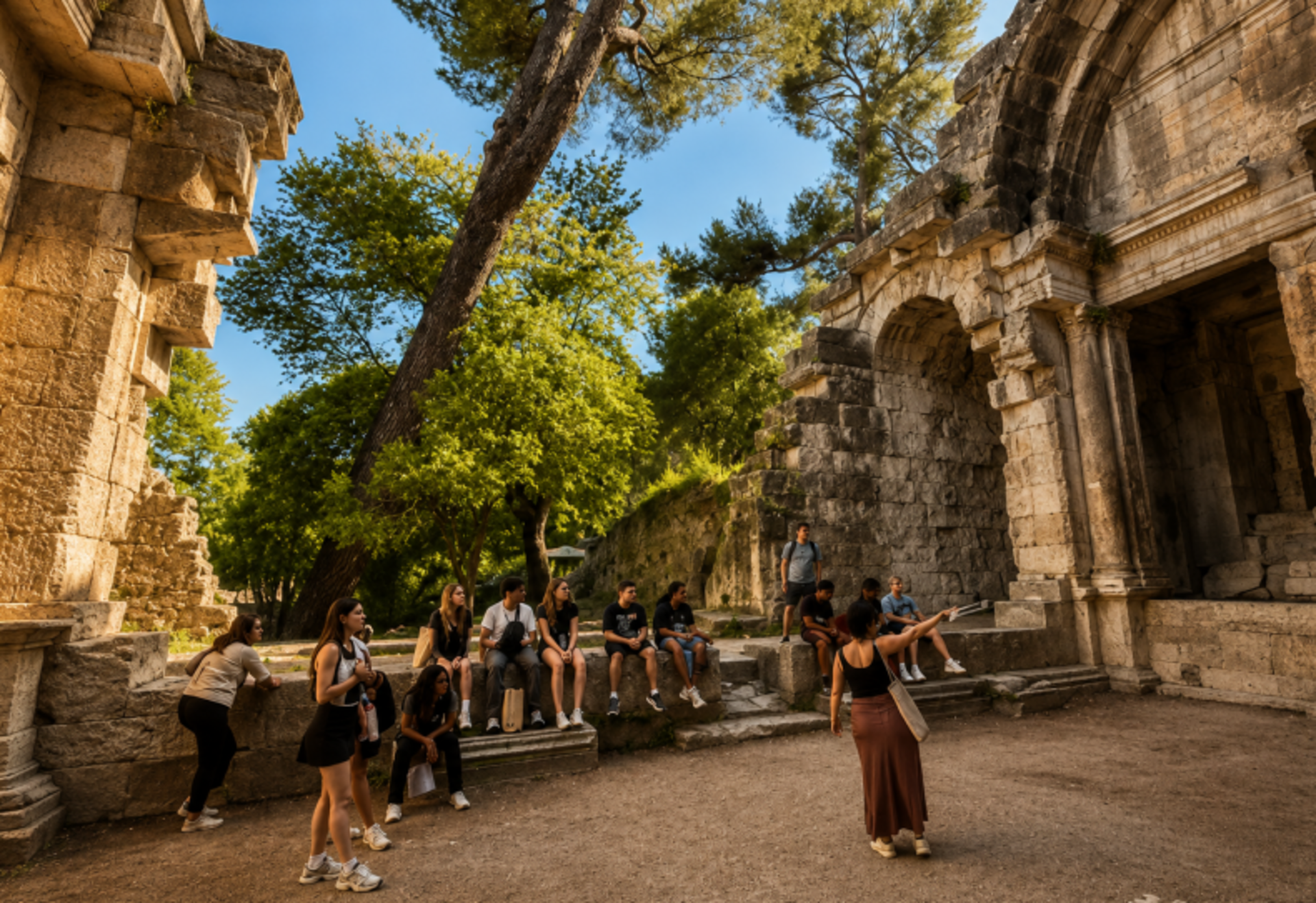
From MotoGP races to Olympic facilities, students explored how athletics can shape cities, communities and global culture.
“You can imagine things in a classroom. But when you’re actually at the place, talking with executives and having open-ended discussions with people doing the work, it changes everything.”
The first thing Guilford College students notice is the noise.
Not the roar inside the stadium at Barcelona’s Camp Nou where thousands rose together in a wave of red and blue. Not the motorcycles screaming around the MotoGP track outside the city. Not even the whistles and chants echoing through narrow European streets long after midnight.
It's the quieter sound beneath all of it.
The conversations. The accents. The languages. The executives speaking candidly about billion-dollar sporting events and tiny nonprofit federations in the same breath. The sound of students from Guilford College trying to absorb it all while standing thousands of miles from the classrooms where the journey began.
For 10 days this spring, a group of Guilford students are traveling through Spain, France, Monaco and Italy, weaving between some of Europe’s most iconic sporting venues and some of its most influential sports organizations. They attended a MotoGP race Sunday morning and an FC Barcelona match later the same day. They’ve toured Olympic facilities and high-performance training centers. They’ve sat with executives responsible for staging international competitions and sustaining sports many Americans rarely see on television.
And somewhere between the lectures and the train rides and the endless walking tours through Roman ruins, something else is happening.
Their world is getting bigger.
“You can imagine things in a classroom,” Darrius Safavi-Abassi ‘26 says while climbing a steep stone staircase toward a Roman watchtower in Nîmes, France. “But when you’re actually at the place, talking with executives and having open-ended discussions with people doing the work, it changes everything.”
The trip is moving quickly, almost breathlessly.
One day students are standing inside the Olympic Museum learning how the 1992 Barcelona Games transformed an entire city from an industrial landscape into a global tourist destination. Another day they’re touring a Catalonian high-performance center focused on supporting athletes in sports like gymnastics and water polo — disciplines driven less by ticket sales and celebrity than by public investment and community impact.
Then there were the sporting spectacles themselves.
Seventy-five thousand fans packed into a MotoGP motorcycle race outside Barcelona. Students studied sponsorship activations, crowd behavior and event logistics while motorcycles tore around the track at terrifying speeds. Hours later, they boarded a train to watch FC Barcelona play before a stadium pulsing with song and emotion. For some, it was a lifelong dream fulfilled in a single night.
But the trip is not limited to sports.
Check out Guilford's International Sport Management study abroad trip
That became obvious somewhere in southern France, where restaurants closed in the middle of the afternoon not because business was slow, but because life, there, moves differently.
Michael White, who directs Guilford's Master's of International Sport Management program, says students are beginning to notice the contrast.
“They see people willing to stop, have dessert, drink coffee, enjoy themselves a little bit,” Michael says. “As opposed to feeling the pressure of daily efficiency all the time. They’re seeing there’s other ways to live a life.”
Guilford’s students are learning how to navigate unfamiliar train systems where they can’t read every sign. They’re learning how to communicate across language barriers.They’re learning how to live together for 10 straight days – sharing meals, schedules, frustrations and discoveries.
And perhaps most importantly, the’re learning that sports can serve wildly different purposes depending on where you stand.
In Catalonia, students heard leaders discuss athletics not simply through wins and losses, but through social impact — how sports organizations partner with hospitals, support research initiatives and contribute to communities beyond the scoreboard. Darrius, a Business major with a minor in Sport Management, hopes to work in business operations for a sport organization. He is fascinated by how European sports secure funding and sponsorships outside the massive commercial systems common in American athletics. “Completely different model for them that might be worth looking into in (America),” he says.
The lessons did not arrive neatly packaged.
They emerged during long walks through Gothic quarters and ancient Roman cities. During late-night conversations between classmates. During moments of exhaustion on crowded trains. During quiet pauses staring out over the Mediterranean Sea.
Study abroad brochures often promise students a “life-changing experience,” a phrase so overused it risks meaning nothing at all.
But there are moments when education escapes the confines of syllabi and fluorescent classroom lights and becomes something tactile and unforgettable.
A student standing inside a European stadium realizing sports can unite an entire city.
A future executive learning how another culture values community over profit.
A group of young people from a small liberal arts college in North Carolina discovering they are capable of navigating a much larger world than they previously imagined.
Somewhere along the way, Michael says, the educational experience stops feeling theoretical.
It becomes real.
Not because of what they saw.
But because of who they were becoming while seeing it.
“You can watch videos and read case studies all day long,” Michael says. “But there’s something different about standing in the middle of it – hearing the languages, feeling the atmospheres, figuring things out together. That’s when students start realizing the world is a lot bigger than they thought, and maybe they’re more capable than they thought, too.”