

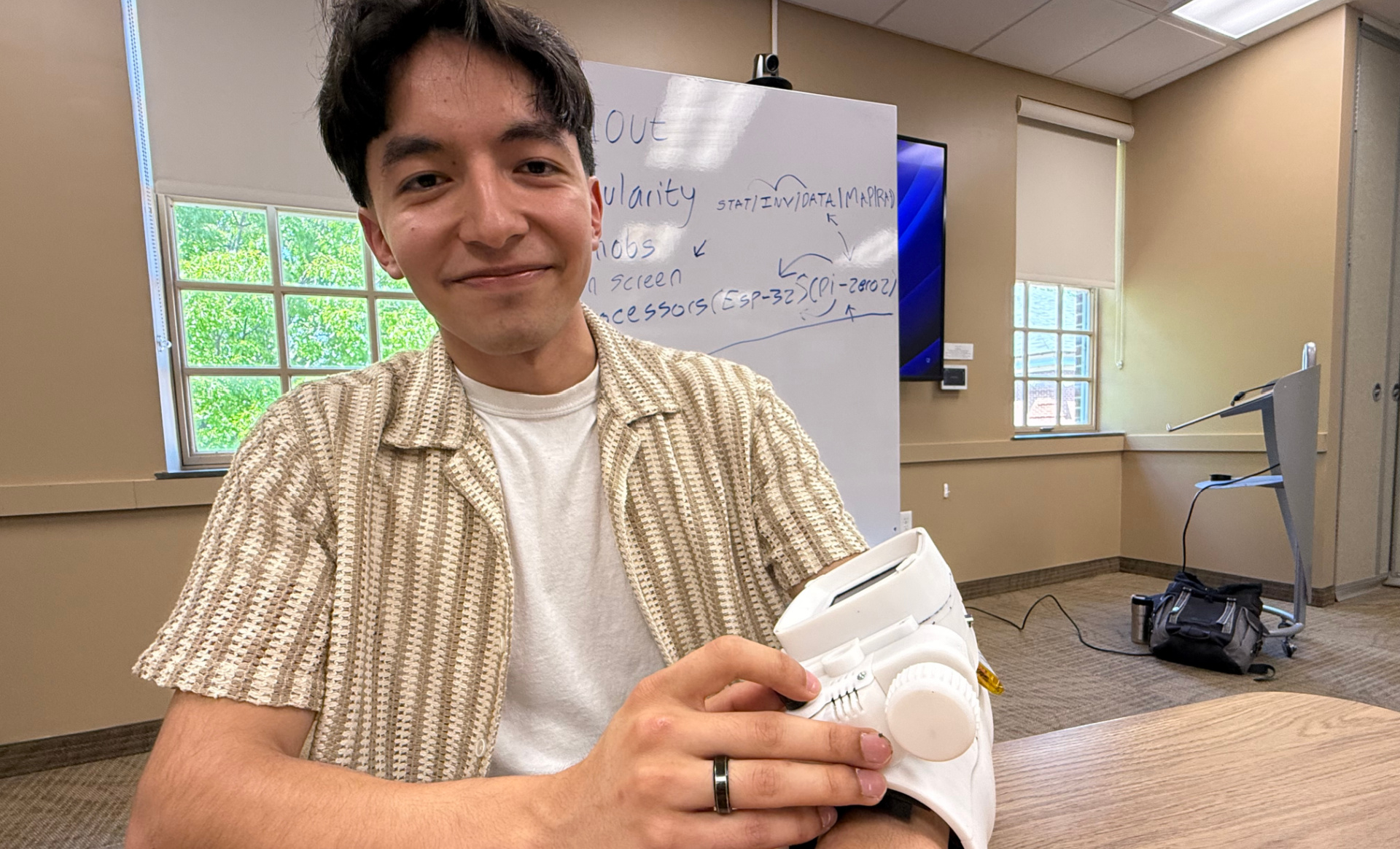
Erick Trejo Velazquez '26 built a retro smart watch inspired by the TV show "Fallout."
Each spring, the Guilford Undergraduate Symposium turns curiosity into something you can see and touch — this year, even wear.
“I originally really struggled on finding an idea for what I wanted to do for my project. But I kind of wanted to dial down my scope and look at things that we as people use in our day-to-day. And that’s how I landed on smartwatches.”
Erick Trejo Velazquez ’26 has spent his senior year at Guilford College imagining a future that looked a little like the past: grainy screens, clunky controls, machines built to last.
So when the Cyber & Security Network major found himself needing inspiration for a Guilford Undergraduate Symposium project, he went back to one of his favorite TV shows, “Fallout” — a post-apocalyptic drama that follows survivors emerging from underground vaults into an irradiated wasteland.
In “Fallout,” characters rely on Pip-Boys — chunky, wrist-mounted computers used to track health, map the wasteland, manage gear and play cheerful retro media, all glowing with that signature green interface that feels both reassuring and eerily out of place in a ruined world.
On Wednesday, Erick offered his own working version of a Pip-Boy, reimagined as a custom-built smartwatch. It’s oversized and imperfect, but purposeful — a system that pulls in weather data, runs on dual processors and reflects his interest in how older, more rugged technologies managed to do so much with so little.
Erick and his retro smartwatch were one of 91 presenters at the College’s annual symposium at Hege Library, where student projects — equal parts curiosity and academic research — turned imagination into something you could see, touch, discuss and, in Erick’s case, wear.
“I kind of connected the idea between smartwatch systems and the Pip-Boy,” he says, “and that’s where the idea spawned from — to recreate that and study the systems behind it.”
That idea, he admits, didn’t come easily. “I originally really struggled on finding an idea for what I wanted to do for my project,” he says. “But I kind of wanted to dial down my scope and look at things that we as people use in our day-to-day. And that’s how I landed on smartwatches.”
What drew him deeper wasn’t just fandom, but a fascination with a different vision of innovation — one rooted in durability and ingenuity rather than sleek minimalism. “Just seeing how these systems were built from almost nothing and how tough they are, how enduring they are, but also how practical they are,” he says. “They’re capable of accomplishing so many different tasks.”
The result is a first prototype that works — but, like most good ideas, leaves room for refinement. If he could start over, Erick says he would spend more time selecting components, especially those that affect consistency and stability. “Some parts are just easier to work with,” he says. “They lend themselves to a better overall product … making sure that I can get a more stable kind of system working.”
Watch video highlights of 2026 GUS
Even in its early form, he sees potential beyond the classroom. “Yes, albeit a niche one,” he says of a possible market. “If we can make the system something more practical, give it stronger features, give it a stronger build overall … I think there definitely might be [interest], even if it’s just amongst enthusiasts or people who are fans of the series.”
GUS attracts some of Guilford’s best and brightest to show off their research and ingenuity. Presentations ranged from Psychology major Hanna Ajayi’s '28 presentation on the ethics of war to an app by Isaac Garbia '26 to help soccer fans plan a vacation around the World Cup this summer.
Here’s a rundown of all the students and their presentations:
- Maeve Dunkerley: “A Night Out: Exploring the Intimacy of Friendships Between Women”
- Hannah Ajayi: “The Ethics of War: Exploring Violence, Injustice, and Just War Theory”
- Wilmer Acevedo Quezada and Kirsten White: “Network Security Lab”
- ZyQuan Williams: “Healthcare Breach Impact Calculator”
- Andy Diaz Villatoro: “Building a Malware Analysis Lab with Open-Source Tools and Repurposed Hardware”
- Ryan Shoenthal, Ahmaad Abdul-Haqq, Tori Collins, Timothy Rundle and Amziel Chioke: “Recursive Generativity: The Eternal Beginning of Fiction”
- Shemar Roberts: “Benefits of Music Therapy”
- Bec Cormack: “Wooded Wattage: A Visual Representation and Celebration of the Legacy of WQFS at Guilford College”
- Meghan Heaney: “Teacher Perceptions on How Dance/Movement Can Impact Student Literacy Skills”
- Joseph Lambert, Christopher Anderson, Aiden Shimpi and Gabriel Peña: “Der goldene Schlüssel: Grimm’s Fairy Tales and their Meanings”
- Brady Odell: “The Limits of Ideology: Behind Japan’s Acceptance of Surrender”
- August Hutchins and Teri Quick: “Analyzing Australia’s Social Media Ban in Real Time”
- Elizabeth Martinez, Areli Patterson, Trinity Whitfield and Brianna Campbell: “Development of a Community Serving Garden”
- Ryne Rodrigues: “Pumped, the Gym App”
- Wilmer Acevedo Quezada: “Elderly Home Assistant”
- Isaac Garbia: “PlanPlayGo: A Guide to Your Ultimate World Cup Experience”
- Wyatt Hawks, Robin Tucker and Aidan Shimpi: “Against the Grain: Subcultures, Conscience, and Policy”
- Charlie Miller, Juno Steele, Sole Williams-Brewer and Cristina Dellinger: “The Creation of the 2026 Greenleaf Review”
- Aya Abdalla, Dhruv Revankar, Joel Sekyema and Aura López-García: “Crónicas de la Antártida”
- Nataly Aguilar, Ava Arias, Courtney Bradford, Denisse Castro and Janey Galek: “Ser o estar?”
- Abid Husain, Favour Faleye, Emily Zhang, Nick Jamieson and Dara Adegoroya: “WEIRDOS en Terapia”
- Ariadna Sosa and Amanda Sayaseng: “Photo-polymer Etching Demo”
- Rebecca Pierre: “Student Advocacy”
- Nayani Annamalai: “Improving Menstrual Health and Sustainability: Menstrual Pads
Redesigned” - Emma Butts: “Death Cycles: Pre-Colonial Inuit Views of Death, Afterlife, and Continuity”
- Emma Evans: “Reincarnation Through the Lens of Embodiment”
- Aprilia Grimaldo-Welsh and Gabriel Peña: “Climate Crisis Mapping”
- Erick Trejo Velázquez: “Modular Smartwatch ‘Pip-Boy’ System”
- William Decareaux, Amziel Chioke, Parker O’Keefe, Fiona Lewis, Maddie Thaxton, Madison
Underwood, Jane Uebbing and Claire Dumont: "Senior Art Thesis: Peripheral" - Z Tate: “Ayahuasca and the Market for Enlightenment”
- Richard Acquaye: “Radio DJing: Dealing with Musical Enculturation, Censorship, and Misinformation”
- Ezekiel Blanchard: “Why Are There Tales of Flying Reindeer?”
- Natalie Moore: “Synergistic Effects of Iberin and Sulforaphane on Triple Negative Breast Cancer cell line MDA-MB-231”
- Elizabeth Martinez: “Optimizing Mechanophotocatalysis Redox Reactions”
- Hayden Moody: “Tuning Photochemical Properties of [2.2] Paracyclophanes Through Isomer, Electronic Donor/Acceptor, and Steric Modulation”
- Mohammad Agha Mohammadi: “Multi-purpose Operational Unmanned Aerial System for Emergency Response and Environmental Monitoring (M.O.U.S.E.)"
- Natalia Alfaro Diaz, Corey Hayes, Terrence Jackson, Taiwo Jones and Marnie Lasher: “Sustainable Textiles: From Raw Fiber to Woven Textile”
- Liliana Arias: “Measuring the Wavelength of Visible Light with the Michelson Interferometer”
- Jana Bassalat and Mohammad Agha Mohammadi: “Open-Source Capture the Flag in Education”
- Adeline Beatty-Squire and Hayden Moody: “The Urban Core Sample: 1392 East New York
Avenue and The Corner of W First Street and N Spring St” - Shanmukh Malyala and Jimmy Ma: “Variable or Not? Investigating Stellar Brightness Variability Through Photometry”
- Kylie Muse: “Identifying Bacteria from Turf Burn using Microbiology Lab Techniques”
- Vihaan Sesetty and Joel Sekyema: “Computational Analysis of Sackur-Tetrode Deviations in High- Pressure Real Gas Mixtures”
- Elijah Troop: “Running With the Wolves: How You Can Study Wolves in Minnesota!”
- Elijah Troop, Ella Barton-Biegelsen and Tanner Royals: “Spiders In the Spotlight: Orb Weavers and Artificial Light at Night”
- George Wall: “A Quantitative Overview of The Microplastics Found in Preserved Samples of Spottail Pinfish (Diplodus holbrookii)”