

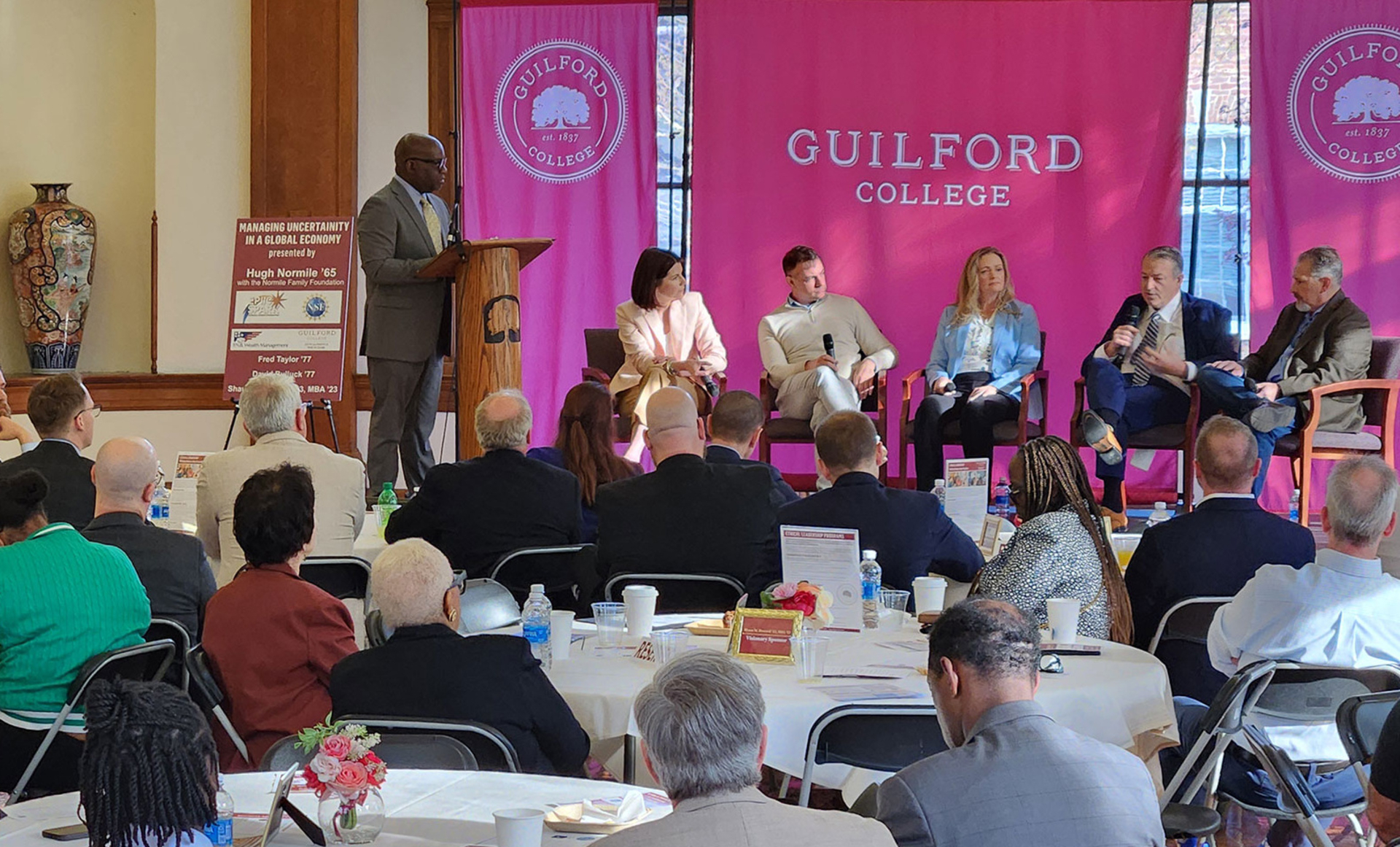
More than 100 business leaders and students atttended Friday's Guilford College Business Summit.
Leaders from across industries share strategies for navigating global disruption—from supply chains to workforce development—while emphasizing collaboration as the path forward.
“You can’t run away from what a decision someone makes in France may impact you. Managing uncertainty requires not just analysis, but solutions and the courage to make decisions.”
Business leaders from across government, manufacturing, technology and energy sectors gathered Friday morning at Guilford College to discuss how organizations are adapting to an increasingly uncertain global economy.
The annual Guilford College Business Summit, presented by Hugh Normile ’65 and the Normile Family Foundation and themed “Managing Uncertainty in the Global Economy,” brought together five panelists and was moderated by Shaun Howard ’13, MBA ’23, Lenovo's worldwide Operations and planning manager.
Panelists included:
- Mary Wilson, chief of staff and general counsel for the North Carolina Department of Commerce
- Daren Barnes, Strategic Procurement Manager, Cone Denim
- Eric Ellis, higher education strategist for Lenovo
- Brian Moore, executive vice president and president of Unifi Manufacturing
- Anna Axelson, vice president and head of battery industrialization and logistics for Volvo Energy North America
After opening remarks by Greensboro Mayor Marrikay Abuzaiter, Shaun opened the discussion by emphasizing the interconnected nature of today’s economy, noting that decisions made abroad can have immediate local impacts.
“Global decisions could impact you locally. A decision made in France may impact you,” he said. “Managing uncertainty requires not just analysis, but solutions and the courage to make decisions.”
Panelists addressed how their organizations are responding to global disruptions, including supply chain instability, regulatory shifts and changing consumer demand.
Mary said the state has focused on creating consistency where possible, particularly through workforce development and stable incentive programs.
“One thing that we know that businesses need is certainty where the state can provide it,” she said, noting that clear expectations and accountability are critical when public funds are involved.
Brian described how Unifi has adjusted operations to remain competitive amid global volatility, including downsizing domestic facilities and redistributing resources internationally. He emphasized the importance of maintaining strong financial fundamentals during uncertain periods.
“All you can do is keep your powder dry,” he said. “Make sure you have a healthy balance sheet, strong cash flow and the right cost structure.”
He also pointed to broader global pressures, including tariff uncertainty and fluctuations in oil prices, which directly affect textile production costs.
Daren highlighted similar challenges in the textile industry, citing shifts in consumer behavior since the COVID-19 pandemic and increasing regulatory demands. He said companies must remain flexible and diversify supply chains to mitigate risk.
“Consumer demand is at the top of the list,” he said, adding that businesses must respond more quickly to market trends while maintaining compliance with evolving regulations.
Eric focused on the role of higher education in preparing a workforce capable of adapting to rapid change. He said institutions must adopt flexible strategies and leverage emerging technologies such as artificial intelligence to improve learning outcomes.
“The goal should be, what do your students need to succeed?” he said, noting that partnerships between colleges and industry are essential to aligning education with workforce needs.
Anna discussed how Volvo Energy is addressing uncertainty in the electric vehicle sector, particularly around sourcing critical battery materials. She said the company is prioritizing North American supply chains and investing in recycling to reduce reliance on foreign resources.
“We need to make sure that we create more of a self-sufficient pool of materials,” she said.
She added that Volvo is transitioning from a linear production model to a circular one, in which battery materials are reused and reintegrated into future production.
“Uncertainty opens up a lot of possibilities”
Earlier in the summit, Guilford College President Jean Bordewich used her opening remarks to highlight the College’s National Science Foundation-funded EPIIC-SPARK initiative as a central strategy for navigating uncertainty—strengthening research, expanding partnerships, and aligning academic work with real-world industry and community needs. She also said that uncertainty creates opportunity, pointing to the College’s successful effort last year to maintain its accreditation while reconfiguring both current and future annual budgets.
“Uncertainty opens up a lot of possibilities because you are forced to think in new ways,” Jean said. “You are forced to find new collaborations, and you are forced to rethink what you’ve been doing and think about how we are going to equip, in our case, our students to thrive in a world that none of us — not even they — can fully see.”
Throughout the discussion, panelists emphasized that while uncertainty cannot be eliminated, organizations can better position themselves by strengthening supply chains, investing in workforce development and maintaining financial flexibility.
The summit concluded with a focus on collaboration, with speakers noting that partnerships between government, industry and education will be key to navigating future economic challenges.
“The partnership ecosystem … is the only way we can affordably navigate the uncertainty,” Eric said, emphasizing the need for closer alignment between colleges and employers.