
At Guilford College, sports are more than a game
Guilford Professor Michael White teaches students to build careers not on wins, but on the experiences that endure.
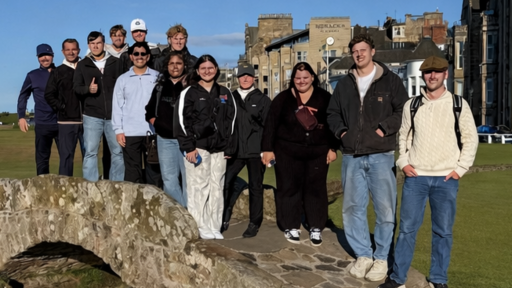
Michael White’s office does not whisper. It talks. Loudly. It tells stories in full color, in framed photographs and media credentials, in the visual shorthand of a life spent orbiting sports. There’s a scarf for the Sydney Swans, an Australian rules football team, hanging from a wall, a photograph from Manchester City F.C.’s locker room resting on his desk. A Masters flag signed by Fred Couples next to his phone. Guilford students standing on the turf at the Sydney Cricket Ground. At St. Andrews. In every photo, they are wide-eyed, jet-lagged, permanently changed.
“You never control whether your team wins or loses. What you control is the experience.”
This is not décor as ego. It is a vision board, syllabus and curriculum blended as one.
Michael, an Assistant Professor for Sport Studies and director of Guilford’s International Sport Management master’s program, understands something essential about sports — and about teaching — that has nothing to do with box scores or championships. Games are a conduit: For connection. For memory. For moments that linger long after the final whistle. His job, as he sees it, is to help students learn how to build lives and careers around that truth.
That philosophy did not emerge in a classroom. It began decades earlier in the eastern Tennessee community of Elizabethton. Michael grew up in a house where sports were not background noise but a shared language. His father, Gary White, was a postal employee and a devoted sports fan who didn’t simply watch games — he inhabited them. He learned fight songs. He took his children to stadiums. He turned his fandom into family glue.
Michael laughs remembering how his mother used to say the only way he would fall asleep as a baby was if Gary rocked him and sang the Washington NFL team’s fight song — “Hail to the Redskins” — as a lullaby. That kind of childhood does not fade. It shapes you.
Michael played everything. He read everything. Like countless kids, he dreamed of going pro. Baseball became his sport, the one that earned him a college scholarship to Milligan College (now University). When the playing days ended — as they do for almost everyone — the sport did not disappear. It simply changed shape.
What followed was a career that zigged and zagged through nearly every corner of the sports ecosystem: journalism, athletic administration, communications, Division I athletics. He is courtside at Duke basketball games and sits in a booth high above Bank of America Stadium for Carolina Panthers games handling stats for both. Each position adds another layer of not only skills, but perspective. Seeing how decisions are made behind the curtain did not diminish his love of sports, it refined it.
“I always saw the business as a means to an end,” Michael says. “The end was people — families, friends, communities — coming together.”
That belief sits at the center of his teaching. On the first day of class, Michael tells students that Sport Management is not a “fun major.” It is a serious one. The U.S. sports industry generates roughly $1.06 trillion in revenue annually, more than the gross domestic product of many countries. The stakes are real. The competition is fierce. And unlike most businesses, the product itself is beyond your control.
“You never control whether your team wins or loses,” Michael says. “What you control is the experience.”
Experience over outcome is a refrain in his classroom. Sports are ephemeral by nature. Fans do not leave with something they can hold in their hands. They leave with stories, emotions and memories. That reality places enormous responsibility on the people who design, market and manage those moments.
Guilford’s Sport Management program prepares students for more than just game days and event operations. The same customer-first mindset applies whether graduates are shaping the fan experience at a stadium, developing products for companies like Nike in the equipment and apparel industry, creating immersive environments for sport entertainment businesses like Topgolf, or building client strategies at major sports agencies such as Creative Artists Agency. “The setting may change, but the core work remains the same,” says Michael. “You need to understand the audience, anticipate their needs and deliver moments that make them want to come back.”
Michael’s classes blend the mechanics of marketing, administration, law and communication with something harder to quantify: ethics, empathy and self-awareness. Guilford’s Quaker roots shape that approach. Classes begin with centering silence. Disagreement is encouraged, but always with respect. Debate is welcomed. Ego is not.
“I tell them, push me,” Michael says. “We can disagree. But we do it as humans first.”
Vivian Cavataio ’28, a double major in Sport Management and English & Media Studies and a member of the volleyball team, says those discussions are what make Michael’s classes distinctive. He frames lectures around questions rather than conclusions, inviting students to engage with the material rather than absorb it passively. The classroom becomes a conversation, anchored in real experiences rather than abstract theory. Seeing the path Michael has taken, she says, makes a future in sports feel attainable.
Michael is equally candid about the less glamorous realities of the industry. He talks openly about layoffs, burnout, long hours and instability. He wants students prepared not just to succeed, but to recover — to know who to call and how to recalibrate when careers veer off course.
That honesty extends to how he uses his professional network. Michael’s connections stretch across the sports world: ACC offices, Duke Athletics, USA Baseball, the NBA, Formula One, local parks and recreation departments and, of course, Guilford alumni in the industry. He treats that network not as personal capital, but as a shared resource.
“I don’t want it for myself,” he says. “I want it for them.”
The results are tangible. Guilford Sport Management students work for MLB, NBA and NFL teams, athletic conferences and international organizations. Some move directly into the industry. Others pursue graduate school, carrying with them résumés shaped by immersion rather than abstraction.
Michael believes sports offer one of the clearest windows into culture — how communities organize themselves, what they value, how they celebrate and grieve. That belief drives the program’s emphasis on international study. Travel is not an add-on, it is a cornerstone.
When students travel abroad, Michael insists on places that carry historical weight. St. Andrews is non-negotiable when the itinerary includes the United Kingdom. Students may not play the Old Course, but they stand on the Swilcan Bridge. They walk the grounds. They feel the gravity of tradition.
Those moments accumulate. They shift how students understand both sports and themselves.
Michael often reminds students that the business of sports is not fundamentally different from any other business. The principles transfer. The stakes simply feel louder. He assigns books like The Power of Moments and Building a StoryBrand not just to teach marketing frameworks, but to reorient perspective.
“Put the customer at the center,” he tells them. “You’re not the hero. You’re the guide.”
It is a philosophy he practices daily. Students drift in and out of his office to talk about internships, résumés, graduate school and life. Some come seeking direction. Others just need reassurance. Michael listens more than he speaks. When he does speak, it is often to nudge rather than instruct.
This is the part of teaching that never appears on a syllabus: the late-night recommendation letters, the follow-up emails months after graduation, the quiet pride of watching former students working courtside at Cameron Indoor Stadium or carving out careers they once thought unreachable.
Michael did not set out to become a professor. At various points, he imagined himself as a Major League Baseball player, a Sports Illustrated columnist, an athletic director. Life intervened. His wife took a job at Duke University, bringing them to North Carolina. He completed his doctorate. A teaching opportunity appeared.
“I didn’t see this coming,” he says. “But I learned to pay attention to where the path was leading.”
That lesson now sits beneath everything he teaches. Careers evolve. Identities shift. Success is not about clinging to a single version of yourself, but about fully inhabiting the role you are given — and remaining open to what comes next.
These days, Michael is firmly rooted at Guilford. He talks about the College the way coaches talk about programs they are building — with urgency, pride and a restless eye toward the future. Alumni engagement. Expanded international partnerships. Conversations around name, image and likeness. Bigger questions about where sports and higher education intersect in a changing world.
His competitiveness remains. It always has. But it is no longer measured in wins or rankings.
It is measured in impact.
“If we do this right,” Michael says, “we create better human beings. And better human beings tend to do pretty well in life.”
Come build your path at Guilford.
Apply, visit, or ask us anything — and your gift, of any size, powers financial aid and the 189-year work of teaching a handful of students at a time.