

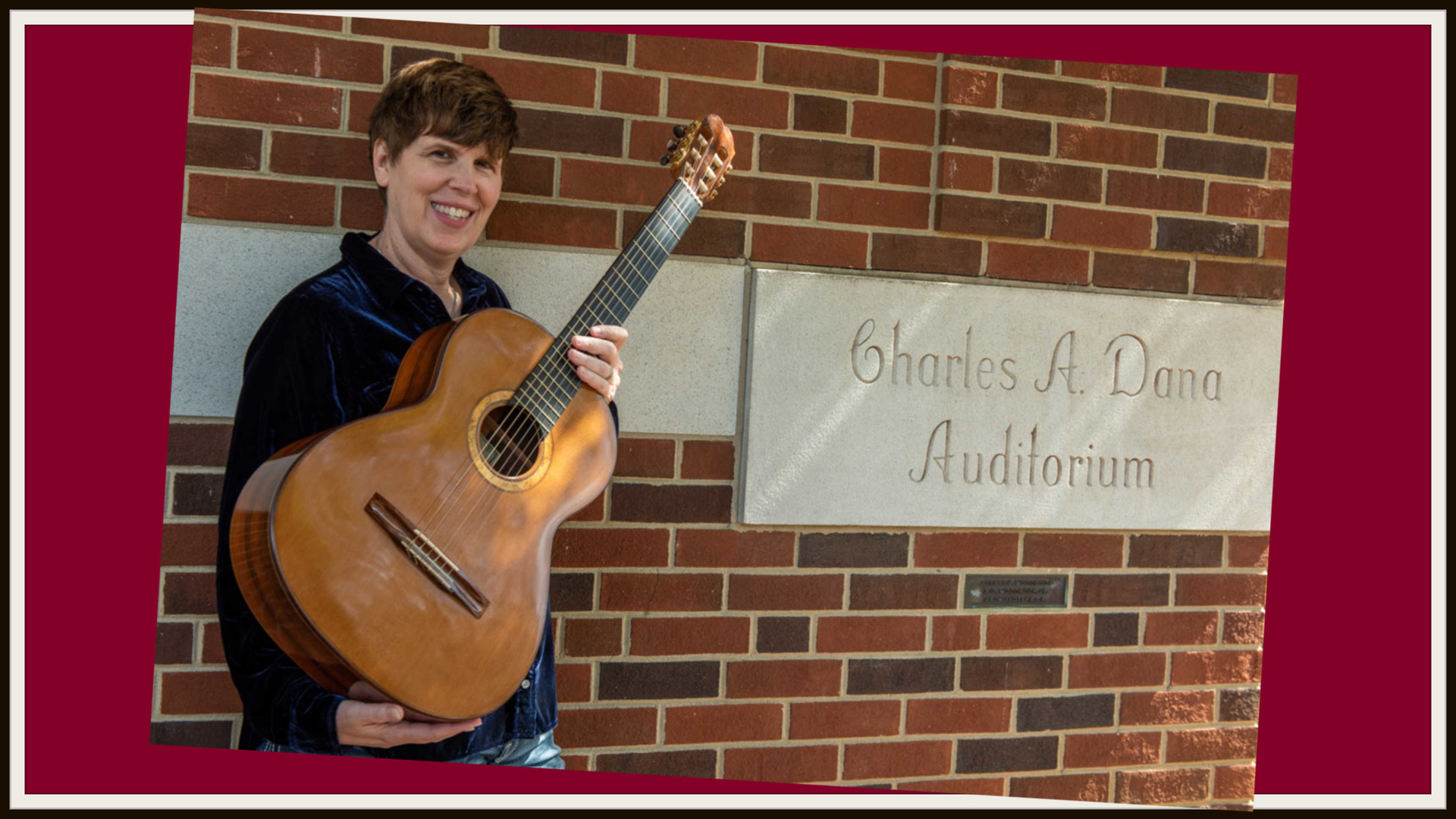
The U.S. Guitar Orchestra Summer INstitute, led by Guilford Provost and Music Professor Kami Rowan, begins July 22.
Nine Guilford alumni helped create Amorevole: Migrating Patterns for Guitar Orchestra as the ensemble prepares to welcome musicians from across the country for its Summer Guitar Institute.
"It's really an eclectic, wide-ranging group this year. We've got folks from all walks of life — students, adults, retired engineers. I'm excited they’re coming together."
For years, if you wanted to hear the U.S. Guitar Orchestra, you had to be in the room.
You bought a ticket. You found your seat. You waited for that curious hush that falls over an audience just before dozens of classical guitars begin breathing as one.
Now, the orchestra has decided to let the music travel instead.
Amorevole: Migrating Patterns for Guitar Orchestra, the ensemble's first commercial recording, is now available on major streaming platforms, carrying with it not only the sound of one of the country's premier guitar ensembles but also the fingerprints of Guilford College.
Nine Guilford alumni and musicians helped bring the project to life: Emmett Edwards ’22, Noah Dabney ’24, Connor Brady ’22, Brendan Lynch ’10, Tucker Gamble ’11, Laura Boswell ’12, Brandon Walker ’22, Mark Charles Smith ’05 and Lexi McGraw ’25, who also designed the album’s cover.
“It’s chock full of alums,” says Kami Rowan, orchestra founder and conductor, who serves as Guilford Provost and Dana Professor of Music. “The talent truly is deep with this group.”
The album features works by more than 20 composers and was recorded over three years in studios throughout the Triad. It is the latest chapter in a program that has quietly built an international reputation while remaining deeply rooted in Greensboro.
The album arrives just as Guilford prepares to welcome another generation of guitarists for the U.S. Guitar Orchestra Summer Guitar Institute, which runs July 22 through Aug. 1 on campus.
For Kami, the timing feels less like a coincidence than a continuation.
Music, after all, is meant to move.
"It's really an eclectic, wide-ranging group this year," Kami says. "We've got folks from all walks of life — students, adults, retired engineers. I'm excited they’re coming together."
Twenty-seven full-time participants, ranging in age from 11 to 70, will spend 10 days immersed in rehearsals, master classes and performances. Some are returning veterans who have toured internationally with the orchestra. Others are arriving for the first time, carrying guitar cases and equal measures of anticipation.
The institute will culminate with a public concert Friday, July 31, at 8 pm at The Pyrle in downtown Greensboro, where audiences will hear the same kind of richly layered sound that now lives on the orchestra's new recording. Tickets are available online.
There is something fitting about an album titled Migrating Patterns.
The music itself has migrated — from rehearsal rooms to recording studios, from concert halls to headphones, from a performance experienced by hundreds to one available to anyone with a phone and a pair of earbuds.
Yet the orchestra's heart remains where it has been for more than a decade.
The Summer Guitar Institute builds on 12 years of classical guitar education and performance at Guilford. Born from the partnership between the U.S. Guitar Orchestra and the former Eastern Music Festival guitar program, it has grown into one of the nation's leading summer workshops for classical guitarists.
Students come to sharpen technique. Professionals come to recharge their artistry. Retired engineers discover there is still something new to learn from six strings.
For Kami, that has always been the point. The institute isn't simply about producing better guitarists. It's about building an ensemble whose members leave hearing one another — and themselves — a little differently.
"The album lets people experience what we've been building for years," she says. "But nothing replaces what happens when people gather in the same room, listen to one another and create something none of them could make alone. That's what this orchestra has always been about."