

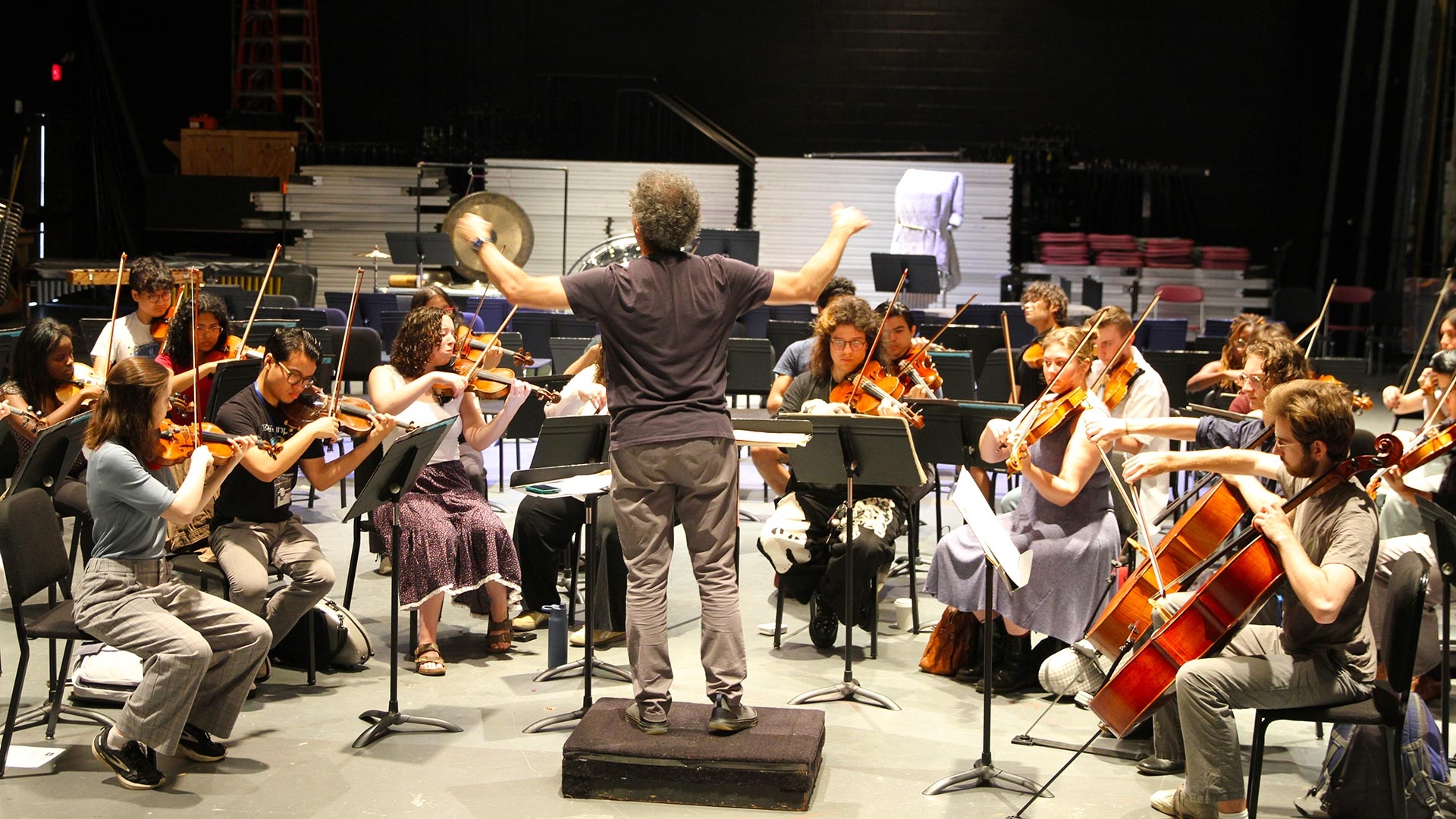
With the Eastern Festival of Music in residence, Guilford welcomes back the students, artists and performances that have shaped summers on campus for generations.
Walk across Guilford’s leafy quad on a July morning and you hear it before you see it.
A trumpet scales upward the closer you get to Dana Auditorium. A violin answers from somewhere across the hall. Down another corridor, a flute floats through an open practice-room door before disappearing into the summer air.
It is the kind of soundtrack that belongs here.
For decades, the Eastern Music Festival transformed the College each summer into one of the country's busiest conservatories, bringing together hundreds of gifted young musicians and faculty from many of America's leading orchestras. When the festival was canceled last summer — and dissolved the following fall — the silence was more than noticeable.
It felt wrong.
Guilford President Jean Bordewich felt it, too.
“We were bereft last summer when it wasn’t here,” she says. “It was very quiet.”
For Jean, the absence represented something larger. The festival and Guilford had grown together for generations, their histories intertwined through thousands of performances, rehearsals and relationships.
“It felt like kind of a dark time because the festival was having difficulties and we were too,” Jean says. “But now Guilford and a new festival are both on the rise.”
Now the sounds are back — as the newly formed Eastern Festival of Music — and with them comes something more important than concerts.
The sounds will continue across campus through Aug. 1, with performances featuring festival students, faculty and guest artists. Tickets and a full concert schedule are available at the festival’s website.
The return of a partnership
What returned to Guilford this summer cannot be measured only in ticket sales or standing ovations.
It is measured in residence halls full of gifted young musicians, many enrolled in or headed for distinguished conservatories or schools of music. In instrument cases moving beneath the oaks. In the energy that arrives when hundreds of artists come together in one place, chasing the same thing.
Excellence.
Founded in 1962, a year after Dana first opened its doors, the festival spent decades at Guilford before previous management suspended operations in 2025. The new festival, under new leadership, is back where generations of musicians built careers and lifelong friendships.
Todd Quinlan understands that history better than most.
He first arrived at Guilford as an Eastern Music Festival student in 2004, later worked for the organization and returned this summer as its Director of Operations.
What surprised him wasn't how much the campus had changed.
It was how many people across campus and throughout Greensboro had been waiting for the festival to return.
“I can't tell you how many conversations started with, ‘I'm so glad you're back,’” he says.
Those conversations weren't just with concertgoers.
Dining Services managers talked about being able to hire seasonal workers again. Vendors who supplied everything from Steinway pianos to golf carts welcomed the festival like an old friend. Campus employees remembered the familiar rhythm of musicians arriving each June.
“You don't realize the impact of something being missing until it is missing,” Todd says.
That’s the thing about the Eastern Festival of Music.
For five weeks this summer, it isn’t simply renting space on Guilford’s campus.
It is becoming part of the campus again.
Many residence halls are filled with musicians. Sidewalks become pathways for students carrying cello cases larger than themselves. Lunch conversations in Founders Hall shift effortlessly from rehearsal schedules to Mahler and Mozart.
The College becomes, if only briefly, one of the country's great music schools.
For Paige Quillen, that transformation is deeply personal.
This fall she will be in her third season performing professionally with the Charlotte Symphony, and today she serves as EFM’s Assistant Operations Manager. But in 2019, she was simply another French horn student trying to absorb everything she could at the festival.
“I have so many good memories from here,” she says.
Watching this year’s students reminds her of the friends she met during her own summer at Guilford — many now holding positions in professional orchestras across the country.
“I know that’s what’s going to happen for this next generation,” she says. “The talent we’re seeing is incredible.”
The faculty is equally accomplished, drawn from some of the nation’s premier orchestras and schools to teach, perform and mentor.
But talent alone doesn’t explain why Guilford works.
The place does.
Partners from the beginning
Ask almost anyone connected with the festival about Guilford, and eventually the conversation turns to Dana Auditorium.
Guilford and Dana have been part of the festival’s story from the beginning. Shelly Morgenstern, a music faculty member at the College, founded it. Jean says the connection helped establish the College as a center for classical music in the summer — a place where world-class performances could happen in an environment that still felt personal.
She believes Dana occupies a special place in Greensboro’s performing arts community.
The auditorium is large enough to hold major performances but small enough that musicians and audiences still feel connected. It is a space built not just for sound, but for listening.
“Dana Auditorium is known for its outstanding acoustics and its size,” Jean says. “This is really for the kinds of performances that require both a sense of intimacy but also really musical quality. It’s a high-quality listening experience.”
Todd agrees.
Most colleges Guilford’s size simply don’t have concert halls like it.
“Dana is extremely unique,” he says. “It meets major professional demands acoustically. You don’t expect to find something like that on a campus this size.”
Paige knows those acoustics from the performer’s perspective.
“The acoustics are some of the best I've experienced at any summer festival,” she says. “Everything blends together naturally. You don't have to fight the room. It lets the music become what it's supposed to be.”
Michael Barranco heard something else when he arrived.
As Associate Director of Operations, this is his first summer at Guilford. Without years of history to compare it against, he noticed what newcomers often notice first.
The people.
“The staff at Guilford has been so quick and attentive to everything,” he says. “Dining Services, Public Safety, everyone has made operating here incredibly smooth.”
Michael attended a small liberal arts college himself, and he believes that is no accident.
Large universities often impress visitors with their size.
Guilford wins them over with its humanity.
That scale matters
Students can walk from rehearsal to lunch in minutes. Faculty members aren’t hidden behind layers of bureaucracy. Musicians encounter one another constantly — inside Dana, beneath the oaks, in Founders Hall, waiting in line for coffee.
Those unplanned conversations become friendships.
Those friendships become professional networks.
Those networks shape careers.
In other words, Guilford doesn’t simply host the Eastern Festival of Music.
It creates the conditions that make the festival possible.
Jean sees that relationship as part of Guilford’s past — but also its future.
As Greensboro continues to grow, she believes Dana and the College can continue serving as a home for performances that require both artistic excellence and a sense of connection.
“We will continue to support the music festival,” she says, “and also explore additional ways to expand the performing arts and Dana and on the Guilford campus.”
But for now, the proof is simpler.
Walk across campus.
Listen.
The music is back. The festival and Guilford are together again.
“This really is a gem,” Todd says.