

At Guilford, Nick Opie found that faith, curiosity and coding can speak the same language.
A double major in Computer Science and Religious Studies, Nick Opie found common ground between faith and technology.
From there, it generates lyrics inspired by those verses, produces original music on his laptop, and creates cover art that visually matches the tone of the music. This isn’t ChatGPT spitting out a few pious stanzas. Nick is quick to draw that line. Text generators can write lyrics, sure, but music is another animal entirely. His system actually composes songs. That distinction matters, especially to Nick.
Part of the project’s backbone is an open-source AI music generator called ACE-Step, which allows users to create music locally rather than on a server owned by a company. That local detail is not just technical trivia — it’s philosophical.
Server side AI often means you don’t own what’s created. Local generation gives you the rights. “You actually own the music,” Nick explains. “It might not be as high quality as server-side stuff, but you can do whatever you want with it.”
Ownership, agency, responsibility – these are themes that run quietly through everything he says.
Nick didn’t walk into the semester knowing this was the project. The idea crystallized a few weeks in, after conversations with Chafic Bou-Saba, Professor for Computing Technology and Information Systems, who floated the general concept of an AI music generator.
Nick’s instinct was not to chase novelty for novelty’s sake, but to personalize it. Christian music wasn’t a gimmick. It is his home turf.
“I listen to Christian music more than anything else,” he says.
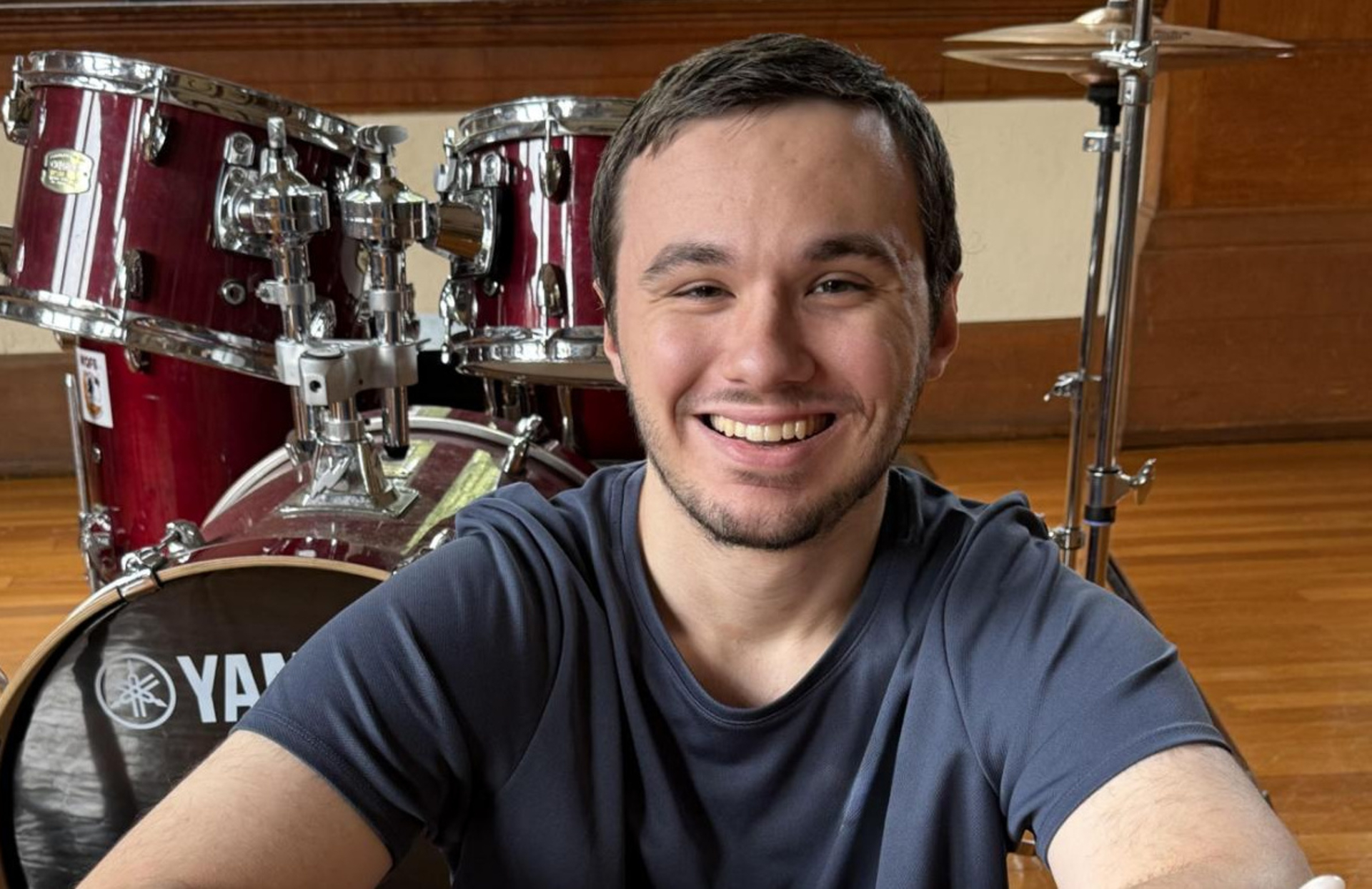
Music has always been part of Nick’s life. He played drums in Guilford’s jazz ensemble for three years, absorbing rhythm and collaboration, learning how sound moves people when it’s performed right.
Faith has always been there too. Nick is active in Cru, the campus Christian organization formerly known as Campus Crusade for Christ, part of a national network of college ministries.
His Religious Studies coursework sharpened that faith rather than sanding it down. If you want to understand why Nick doesn’t see science and belief as opposing forces, talk to him about his classes. He lights up describing Guilford’s Religious Studies faculty and the way they teach students to think.
Not what to think, but how to interrogate ideas, including their own. He mentions a three-week Title IX course taught by Jill Peterfeso, the College’s Eli Franklin Craven and Minnie Phipps Craven Professor of Religious Studies, and the way it reshaped his understanding of women’s experiences and institutional power.
“I learned so much,” he says. “By the end, I felt like I could actually have a real conversation about it.”
That, to Nick, is the point. Faith without thought is thin. Thought without humility is brittle. He doesn’t feel torn between his majors; he feels expanded by them. His AI hymnal project sits squarely in that overlap. It’s technical and devotional. Rigid and interpretive. Built on logic, aimed at mystery.
That doesn’t mean he’s naïve about the implications. Ask Nick whether AI threatens artists, and he doesn’t duck the question. He plays music himself. He understands the anxiety. If a system can mimic a singer’s voice or style, he believes artists have every right to feel unsettled.
“It depends on whether it’s copying someone’s likeness,” he says. “If it sounds exactly like a real person, that’s a problem.”
His own project avoids that by design. The voices are not replicas. The music isn’t trying to impersonate Chris Tomlin or Phil Wickham or Brandon Lake.
Still, he’s realistic about where this technology could go, and how easily lines could blur. What he doesn’t believe is that AI automatically cheapens art. Could someone someday use a tool like his to generate music for personal reflection? Absolutely.
Could that music help someone explore faith privately, tentatively, without the pressure of a worship space or a polished sermon? He thinks so. The tools are already there. They’re open-source. They’re accessible. Music, he insists, is in the ear of the listener. Whether the final piece feels shallow or profound, he argues, depends on the person listening and the prompts guiding the machine.
Depth is subjective. Faith is personal. AI, at least right now, mirrors what we bring to it, he says. He’s candid about the limits, too. Locally generated AI music isn’t yet capable of the kind of deeply probing, soul-wrestling theology that critics of Christian pop music often crave. That kind of complexity may come with time, computing power, and better models.
Or it may always require human hands and voices. Nick isn’t trying to replace anyone. In fact, he doesn’t want to monetize the project at all. By the end, the thing nearly broke him.
He laughs about it now, but there’s still exhaustion under the humor. He used another AI tool — Claude — to help generate code, and it repeatedly deleted critical sections. Fix one thing, another breaks. Music but no image. Image but no music. Late nights. Head-meetsbrick-wall frustration.
“When I submitted it, I was like, ‘That was awesome,’” he says. “‘I never want to look at this again.’”
And that’s okay. Not every meaningful project needs to become a startup. Nick is interning this summer at an IT firm in Raleigh. It’s a path that might raise eyebrows, but makes sense to him.
He worked on Guilford’s IT help desk, seeing how something as simple as patience can cut through frustration. Some people expect to be rushed, talked down to, dismissed.
When that doesn’t happen, it lingers. In that sense, the AI hymnal feels less like a one-off class project and more like a quiet throughline in his life: take what you know, apply it thoughtfully, and leave things a little better than you found them.
Whether that’s code that finally compiles or a person who feels heard, the outcome matters less than the care. Nick shrugs when he talks about it, as if it’s obvious. Maybe it is.
“People are so used to bad service,” he says. “If you can just be kind and do your job well, that actually stands out. That’s how I think about representing my faith — just doing the work right, wherever I am.”