

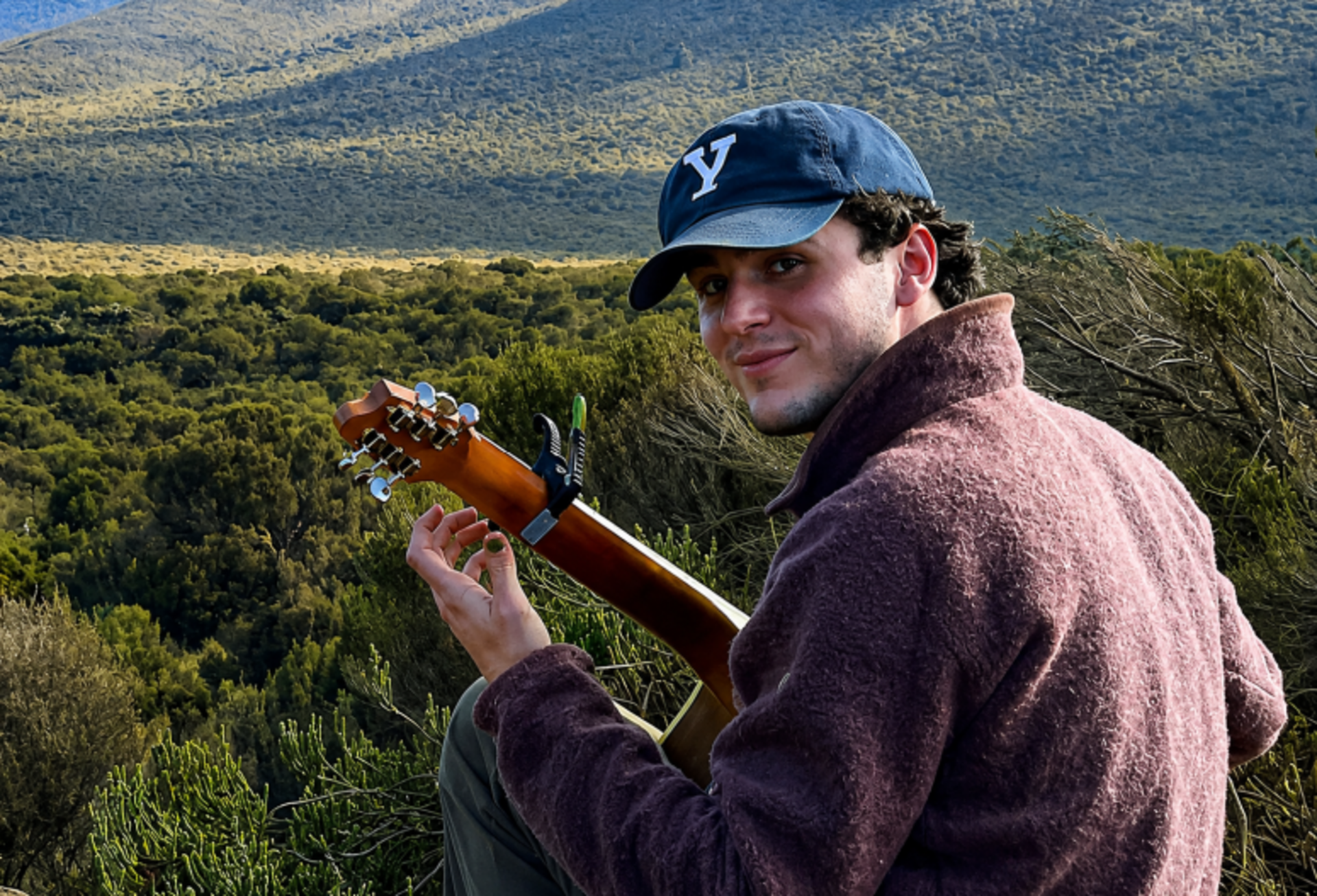
One of the first items Emmett Edwards packed for his ascent of Mt. Kilamanjaro was his guitar.
Before leaving for the Yale School of Music, Emmett Edwards climbed Mount Kilimanjaro, the inspiration for a composition that is headed for publication.
“At Guilford, what I expected to learn in a semester I needed to learn in two weeks.”
Before leaving for the Yale School of Music, Emmett Edwards climbed Mount Kilimanjaro, the inspiration for a composition that was recently published.
The guitar solo begins in the dark. Not metaphorically. Literally. At midnight on Mount Kilimanjaro, Emmett Edwards ’22 was climbing by headlamp, breathing air that felt rationed, trying to keep his legs moving while altitude sickness pressed against his ribs.
Somewhere between base camp and the summit, in that long, unbroken stretch of night hiking, the shape of a guitar composition began to settle into him. Today, that seven-plus minute composition that has its roots in Tanzania is called “Kilimanjaro.”
Three years later, the piece stands as Emmett’s capstone work as a master’s student at the Yale School of Music. It premiered last year at the Saigon International Guitar Festival in Vietnam. Earlier this spring, it was published by Les Productions d’Oz, a publishing house and label dedicated to classical and contemporary music.
But we’re getting ahead of ourselves.
At the start, “Killimanjaro” was nothing more than a few chords bouncing around in Emmett’s head. “I had been starting to write this piece before the trip,” he says. “Something programmatic — something that follows a story.”
The mountain gave him the story. In the summer of 2023, before leaving for Yale, Emmett and his father, Will, traveled to Tanzania to climb Kilimanjaro. They had never left the country together. They’d hiked and camped plenty in the U.S., but this felt different. A line of demarcation before graduate school, before the next life chapter.
Emmett, a Music major at Guilford who grew up playing a guitar, packed a travel guitar for the trip. “I’m the sort of person who couldn’t foresee a world where I don’t play for eight days,” he says.
He didn’t carry it to the summit — that would have bordered on delusion — but he brought it to base camp. At night, over six days in the cold, he wrote fragments. He recorded voice memos into his phone so he wouldn’t forget melodic ideas. He paid attention to what the mountain was doing.
Mt. Kilimanjaro unfolds in biomes. You begin in a jungle – monkeys in trees, humidity pressing in. You climb into heath and moorland, sparse and wind-brushed. Near the top, the earth becomes almost Arctic: rock, ice, thin air.
That progression from lush to spare to stark becomes an emotional arc in Emmett’s piece. “The landscapes were really inspiring,” he says. “And also just the spirituality of the mountain.”
That surprised him most. In Tanzanian culture, Kilimanjaro is sacred ground. Respected. Revered. Hallowed. “It felt like being at a church,” Emmett says. That feeling – not the hiking, not the photo at the top, but the reverence – makes its way into the music.
“Kilimanjaro” does not charge forward like a victory march. It builds. It ascends gradually. The harmonies shift the way terrain shifts. Tension accumulates. Space opens. The summit section widens instead of explodes, a musical horizon rather than a fanfare.
Emmett and Will reached the top after nearly 24 hours of climbing on summit night. “You’re above the clouds on land,” Emmett says. “You’re only ever seeing that from a plane. It’s surreal.”
They stayed maybe 20 minutes. At 19,335 feet, the summit – Uhuru Peak – has less than half the oxygen than there is at sea level. Father and son needed every minute of daylight to begin their descent.
Just like in the piece, the summit does not last long either. Emmett wrote “Kilimanjaro” as part of his master’s degree recital at Yale. The mountain sketches became manuscript paper and hours of disciplined refinement in practice rooms in New Haven, Conn.
If Guilford gave him foundation, Yale gave him acceleration. “At Guilford, what I expected to learn in a semester,” he says, “I needed to learn in two weeks.”
The adjustment was jarring. The first semester felt like being thrown into the deep end with no floaties — expectations rising exponentially, output required at a pace that left little room for doubt. “I don’t think anything really could have prepared me for that,” he says.
But then he pauses. “I had wonderful teachers at Guilford,” he adds. “They gave me tools. They gave me direction that felt personal.”
Guilford, he says, prepared him not by simulating Yale’s intensity, but by helping him develop a voice — one that didn’t evaporate under pressure. Study abroad in Spain. Recitals. Faculty mentorship. A campus culture where music is not a sideshow but a conversation.
“Kilimanjaro” is not just a travel piece. It’s the product of someone trained to think about context – about landscape, spirituality, story. Guilford’s liberal arts lens is embedded in the composition. The mountain is not a backdrop. Emmett says, it is narrative.
The piece traveled farther than its origin. Emmett premiered “Kilimanjaro” at the Saigon International Guitar Festival in Vietnam as part of a Yale guitar studio tour through Thailand and Vietnam.
The performance landed on his birthday. That global arc feels fitting for a work about elevation and perspective.. The setting mattered. A piece born on an African mountain, written in New Haven, first publicly performed in Southeast Asia – that global arc feels fitting for a work about elevation and perspective.
While refining “Kilimanjaro,” Emmett was teaching at Yale as a secondary lessons instructor. Students enroll for credit or as an elective. Some arrive wanting classical repertoire — Bach’s “Lute Suite No. 3.” Others want blues improvisation. One student wanted Emmett to teach him all things Metallica.
“It keeps me on my toes,” he says. “Completely different skill sets.”
He also taught privately in New Haven, working with students of varying ages and backgrounds. Teaching, for him, is not fallback; it is vocation. He speaks about it with the same energy he brings to performance.
And then there is Dogboy. The band began in New Haven with other Yale students and alumni. They perform mostly in New York and will soon record a debut album. The sound? Neo-soul with rock influences — think D’Angelo and Lauryn Hill with a sharper edge, says Emmett.
If “Kilimanjaro” represents discipline and reflection, Dog Boy represents groove and collaboration. Emmett moves between the two worlds comfortably. Bach one day, blues the next. Classical recital hall one week, club stage the next.
It is less a contradiction than a range. Emmett received his master’s from Yale this spring and now lives in New York City. For now, the focus is simpler: Build. Teach. Play. Collaborate.
“In New York,” he says, “for music, somebody of the highest caliber of whatever instrument you want to collaborate with is there. That’s where I want to be.”
The opportunity is dense. The expectations are high. It sounds, in its own way, like another mountain. Which brings us back to midnight. On summit night in 2023, Edwards was exhausted.
He battled altitude sickness. The climb, he says, was “very, very, very taxing.” But he kept going.
That persistence — the willingness to stay with tension, to climb without spectacle — is what makes “Kilimanjaro” resonate. It is not flashy. It is not self-congratulatory. It unfolds with patience, moves through terrain, and understands that the summit is brief. Father and son stayed at the top for maybe 20 minutes.
Emmett laughs. “I hope,” he says, “this piece lasts a little longer.”