

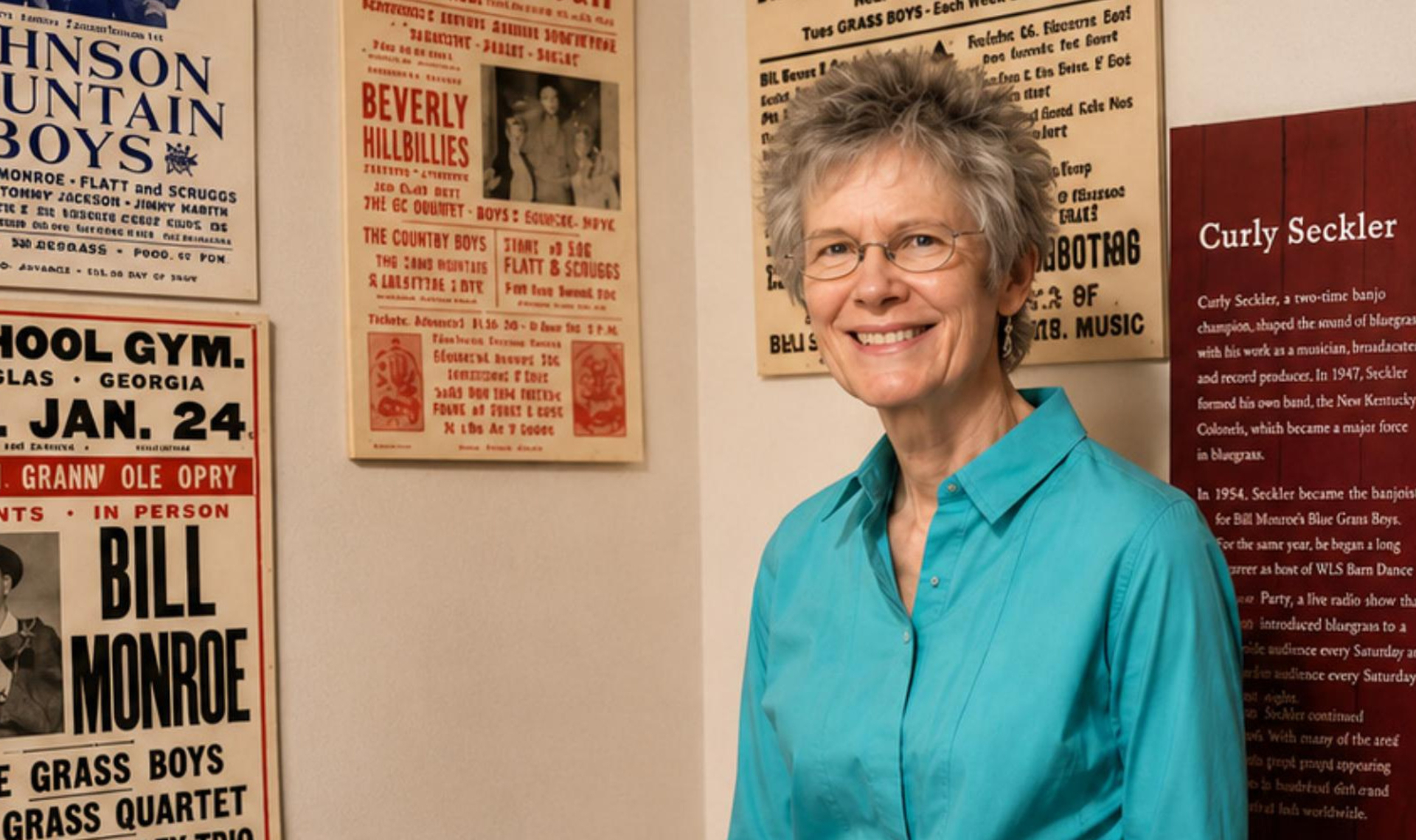
Penny Parsons was recently recognized by the International Bluegrass Music Association with a Distinguished Achievement Award, one of the organization’s highest honors.
Penny Parsons was searching for her place in the world. Guilford and Bluegrass helped her find it.
”I still can’t put into words how I fell for (Bluegrass) music and the energy it produced. I was hooked.”
The funny thing about life-changing moments is that they rarely announce themselves. No spotlights or trumpets or thunder claps from above insisting you pay attention because this one matters. Usually, they’re just another Saturday night.
For Penny Parsons ’75, it was Sept. 16, 1972. Even now, all these years later, Penny remembers the date. She was a first year at Guilford when she saw the flyer on campus that Lester Flatt and the Nashville Grass were playing Dana Auditorium.
She’d seen Lester perform on television and liked the music. That was it. Nothing remarkable. Except it changed everything. “That was the night my life changed,” Penny says. “That’s when I became infatuated with Bluegrass, obsessed with it.”
Last year, more than five decades later, the International Bluegrass Music Association (IBMA) recognized that obsession with a Distinguished Achievement Award, one of the organization’s highest honors.
The award isn’t reserved only for performers. It honors people whose work has strengthened Bluegrass music itself – the writers, historians, producers, promoters and advocates who keep the culture alive. Which is why it fits Penny perfectly. Because while she never became the person standing in the spotlight, she has spent most of her life helping shine it on everyone else.
The story starts at Guilford. Actually, it starts before Guilford. Penny’s father, David Parsons, was the College’s business manager for more than 30 years. Her mother, Cora Worth Parker ’39, was a Guilford graduate.
Penny grew up on campus, long before she enrolled as a student. She remembers the woods. Always the woods.
“Those woods were my home,” she says. “My dog and I would wander all through all the paths in the woods.” She fished in the lake and swam in the lake with her father. Rode her bicycle around campus. “That was where I grew up.”
Like many Guilford students, she arrived without a perfectly plotted future. She majored in Psychology and Religion. At home she listened to Led Zeppelin and Neil Young. She loved Johnny Cash.
Bluegrass wasn’t some inherited calling. It was simply one of many sounds competing for her attention. Then Lester Flatt walked onto a stage in Dana Auditorium. The music hit her differently. Maybe it was the intensity. Maybe it was the emotion. Maybe it was something she couldn’t quite explain.
”I still can’t put into words how I fell for the music and the energy it produced,” she says. “I was hooked.” She followed Lester to other performances around North Carolina. She attended festivals. She subscribed to Bluegrass Unlimited magazine and read every issue. She worked parttime at Greensboro’s Music Barn.
The music stopped being entertainment and started becoming a community. Then came one of those moments that seems accidental until you look back years later. Barry Poss, a pioneer in the world of Bluegrass, old-time, roots and Americana music, of Sugar Hill Records in Durham, N.C., needed an employee and he asked Penny if she was interested.
“He did not have to ask twice,” she says. That one opportunity led to another. Then another. She worked in publicity and marketing. She became involved with MerleFest, the renowned music festival in Wilkesboro, N.C., serving as the festival’s publicist for nine years.
She worked in record distribution. She launched her own company. She wrote articles. She built relationships throughout the industry. Looking back, she sounds a little surprised by all of it.
“I certainly didn’t expect it to take me as far as it did,” she says. “I didn’t expect so many of the opportunities that came to me.”
Maybe that’s because Penny never seems to have approached Bluegrass as a career ladder. She approached it more like a fan who kept finding ways to stay close to the music.
One of the best examples arrived in 2003. Someone suggested she visit Curly Seckler, one of Bluegrass music’s pioneers and a longtime mandolinist for Flatt and Scruggs.
Penny figured she might write a magazine article. Instead, she found herself sitting with an 82-year-old legend who had preserved decades of photographs, correspondence and memories.
“I realized that there could be a book there and I really wanted to be the one to tell his story,” she says. The project eventually became a biography published by the University of Illinois Press
Guilford prepared her for exactly this sort of life. Not a specific profession. A way of moving through the world.
“I learned to write when I was at Guilford,” she says. “Not just write but write well, and that has served me ever since.”
Writing became one of her most important tools, allowing her to tell stories, preserve history and connect generations of musicians who might otherwise never know one another. In many ways, her hall of fame recognition acknowledges that work as much as anything else. The award celebrates a lifetime spent documenting a musical tradition and helping sustain it.
These days Penny describes herself as “mostly retired” though the evidence suggests otherwise. She still serves on IBMA committees. She still attends festivals. She still travels to places like Jerusalem Ridge in Kentucky, Bill Monroe’s old homeplace, because the music continues to matter.
And recently, something else happened. The Flat Creek Ramblers, a Bluegrass group Penny helped form with fellow Guilford students in the 1970s, got back together. For decades the band mostly existed in memories and old photographs. Then the musicians reunited.
"It was really cool,” Penny says. That understated assessment feels appropriate. Because the reunion wasn’t really about performing. It was about returning to where the story began. A campus. A group of friends. A shared love of music. And a reminder that the most important journeys often start in places that feel ordinary at the time.
Fifty-three years later, Penny is being honored by the people who know Bluegrass best. But the roots of that achievement still trace back to Guilford College and a September night when a freshman took her seat, listened carefully and discovered the thing she would spend the rest of her life pursuing. “I wouldn’t change anything,” she says. “Somedays I feel like the luckiest person on earth – maybe I am.”