

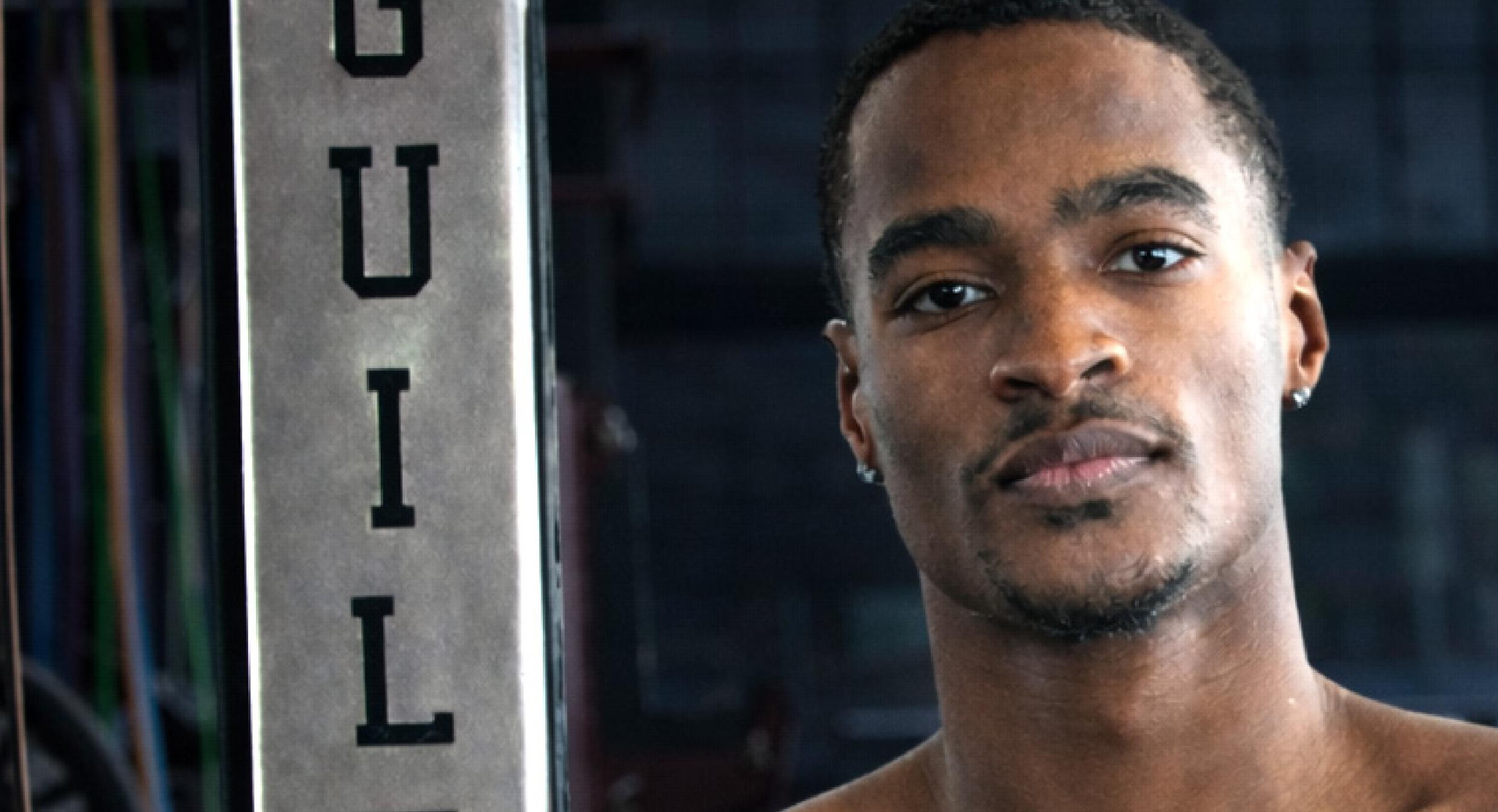
Dawson Edwards says Guilford gave him the tools and inspiration to build his own business.
Three degrees. Zero shortcuts. Dawson Edwards would love to coast if he could only find the time.
“I got an ethical education here at Guilford. That’s going to be huge. Whenever I’m thinking about my idea, I’m thinking about providing value in the best way possible for as many people as possible.”
To the list of questions that have nagged mankind through the ages, add this one: Which version of Dawson Edwards ’24, MBA ’25, MISM ’26 was harder to keep up with — the basketball player or the Presidential Fellow?
On the court, Dawson was as quick as he was elusive, slicing through defenses in his final season with the Guilford Quakers in a transition between head coaches, leading in ways that don’t always show up in a box score. Off the court, he was just as difficult to pin down — running tours for prospective students, printing materials in the Admission Office before most of campus had its coffee, wrapping up a second master’s degree to stack neatly atop his undergraduate diploma.
He is, in short, a study in motion. Spend five minutes with him – if he has that time to spare – and you begin to understand that motion is not restlessness. It’s purposeful. He has a dream, one sketched out on a piece of paper at his kitchen table last year. Every move he makes, every breath he takes is designed to realize the dream.
“I truly want to build my own business one day,” Dawson says, leaning forward as if already pitching it to a roomful of investors. He wants to build a gym – only it’s not just a gym. He wants that gym to have a library. You read that right. And offices and a maker’s space. His target audience is mid-career people and retirees, the ones with the most disposable income. But also elementary, middle and high school students. In short, everybody.
“It’s going to incorporate a little bit of sport, a lot of the operational stuff I learned during my MBA — but really it’s going to incorporate relationships and community.”
Relationships and community. When Dawson speaks, those words return again and again, like a drumbeat. Those words, he admits with a grin, are the very reasons he chose Guilford in the first place.
He grew up in Durham, N.C., in a world textured by Sunday mornings and public school hallways
“First thing I think about is church,” he says about growing up. “My parents always made sure we were up and there every Sunday. Sunday school — that’s where I made my first friends.”
Those friendships often stretched beyond school boundaries. Many of the children he knew from church attended private schools or different public schools. The diversity of his early education left an imprint.
“We were learning about Black history, Hispanic history — in fifth grade,” he says. “In college I’d hear people say they barely learned about that in middle school or high school.”
In eighth grade, he completed a community service project that quietly altered his trajectory. He chose to interview members of Durham’s homeless community. One man stood out — a military veteran whom everyone assumed was living on the streets. “He wasn’t,” Dawson says. “He lived with his sister. He had family. He just walked the streets every day picking up trash.”
The man had been shot multiple times in war. He had been diagnosed with PTSD and paranoia. And yet he rose each morning to clean highways running through and around Durham.
“He felt a duty to make the planet look better,” Dawson says. “People thought he was homeless, and he was just living his best life.”
That lesson — that purpose is not always glamorous, that fulfillment is not synonymous with applause — stayed with him.
So when colleges began circling during his senior year of high school, he weighed more than playing time. An assistant coach from Guilford watched him compete in a game crowded with recruiters. UNC Greensboro, a Division I program, deemed him undersized. Former Guilford head coach Tom Palombo saw something else.
“His leadership on the floor is what I noticed first,” says Tom, now the associate head coach at Longwood University. “That’s not always something you can teach a player, but Dawson had it in him in high school.”
By the time Dawson visited campus, basketball was only part of the equation. “Relationships and community, that’s all I heard about Guilford,” Dawson says. “So I thought, let me just go to campus and see what it’s about. After visiting, I was convinced.”
At Guilford, he found not just a roster spot, but a runway. He completed his undergraduate degree in Business Administration. He added an MBA and, in 2026, a Master’s in International Sport Management.
Along the way, he became one of four Presidential Fellows for 2025-26 – recent graduates who work in a department on campus while earning a master’s degree at Guilford. The Presidential Fellowship is a “win-win” program fostering leadership and providing practical experience in higher ed for students. For Dawson, it was a role that places him in the room where decisions are made.
“One of the biggest things I made clear on my (Presidential Fellowship) application was how much I love Guilford College, and I want to be a part of its direction,” he says. “As a student you can have input. But when you have a staff position, you can really be in the room when decisions are made. Your perspective is more considered.”
If that sounds ambitious, it is. But it is also disciplined. His typical Monday was like a time-management case study.
He woke at 7:30 a.m., walked Maximous, his Golden Retriever, before reporting to work in Hendricks Hall. He printed materials for morning tours, fielded calls and shepherded prospective families across campus. Around 11 a.m., he squeezed in a workout if practice loomed. The last tour wraps at 2:30; he headed straight to practice.
After practice, the team lifted. Then home to Maximous. Then homework. Then, perhaps, a late-night conversation with Natalie Moore ’26, his girlfriend who graduated from Guilford in May with a Biology degree.
The arithmetic of his days required some heavy lifting of discipline and time management until, he says, the darting around campus, weight lifting, studying and basketball becoming less a chore and more routine. “Sometimes you hit a wall and say to yourself, ‘man, I need some personal space.’ But after doing so much and wanting to be involved in so much, it becomes your life. I’d rather be a part of change than watch change happen and have no input.”
Basketball provided the crucible.You can’t show up five minutes before practice and expect to be ready,” he says. “There’s preparation.”
He laughs as he recalls his high school coach’s mantra: proper planning and preparation prevent poor performance — the “six P’s.”
At the time the line, to keep the alliteration going, piqued Dawson. In college, it made sense. “A failure to plan is planning to fail,” he says. “Once you’re thrown in the fire, you understand and my time at Guilford has been one big fire. A good kind of fire. It’s made me stronger and ready for what comes next.”
Not surprisingly, Dawson was one of the basketball team’s captains. Leadership, he believes, is less about speeches and more about stamina. “Being a team captain, you feel responsible for the direction of the team. And once you start working, it’s the same thing. You’re going to feel responsibility if the project succeeds or fails.”
Back to Dawson’s dream. The idea sparked at 2:30 a.m. at a kitchen table, before a predawn retail shift at Target. Dawson and a roommate began sketching what downtown Greensboro could become if they had the land.
“I thought, everyone builds athletic facilities,” he says. “What would I want to build? A place where community and ambition collide.”
The concept has since grown into something like a hybrid of a YMCA, a co-working space, a library, and a civic commons. There would be fitness facilities, yes, but also career fairs, speaker series, food spaces, professional learning areas.
“It’s like reinventing the college experience without classes,” he says. “Open to all ages.”
He has mapped it down to phased construction. He has run feasibility scenarios. It’s all right there in a Google Doc. He’s convinced his Guilford MBA will give him the edge he needs when it’s time.
“I got an ethical education here at Guilford,” he says. “That’s going to be huge. Whenever I’m thinking about my idea, I’m thinking about providing value in the best way possible for as many people as possible.”
Guilford professors emphasize ethics and feasibility. But perhaps the most important lesson Dawson has absorbed at Guilford is persistence. “If you have a dream, you can do it,” he says. “It might not happen in a year or two. But who’s to say it won’t happen in the third?”
For now, his path is practical. He’s working in Admissions, but he plans to pursue work in real estate or as a sports agent, careers adjacent to his interests that will allow him to build capital and connections.
“It’s a starting point,” he says. “I still get to have relationships with people. I still get to impact the next generation.”
And one day, when the timing is right, perhaps that sketch from 2:30 a.m. will become brick and steel and glass — a place where community and ambition collide. Guilford didn’t hand him the dream. It gave him the space — and the discipline — to refine it.
“This place taught me to be okay with the process,” Dawson says. “Finding your dream isn’t quick. But if you keep preparing, you’ll be ready when it’s time.”