

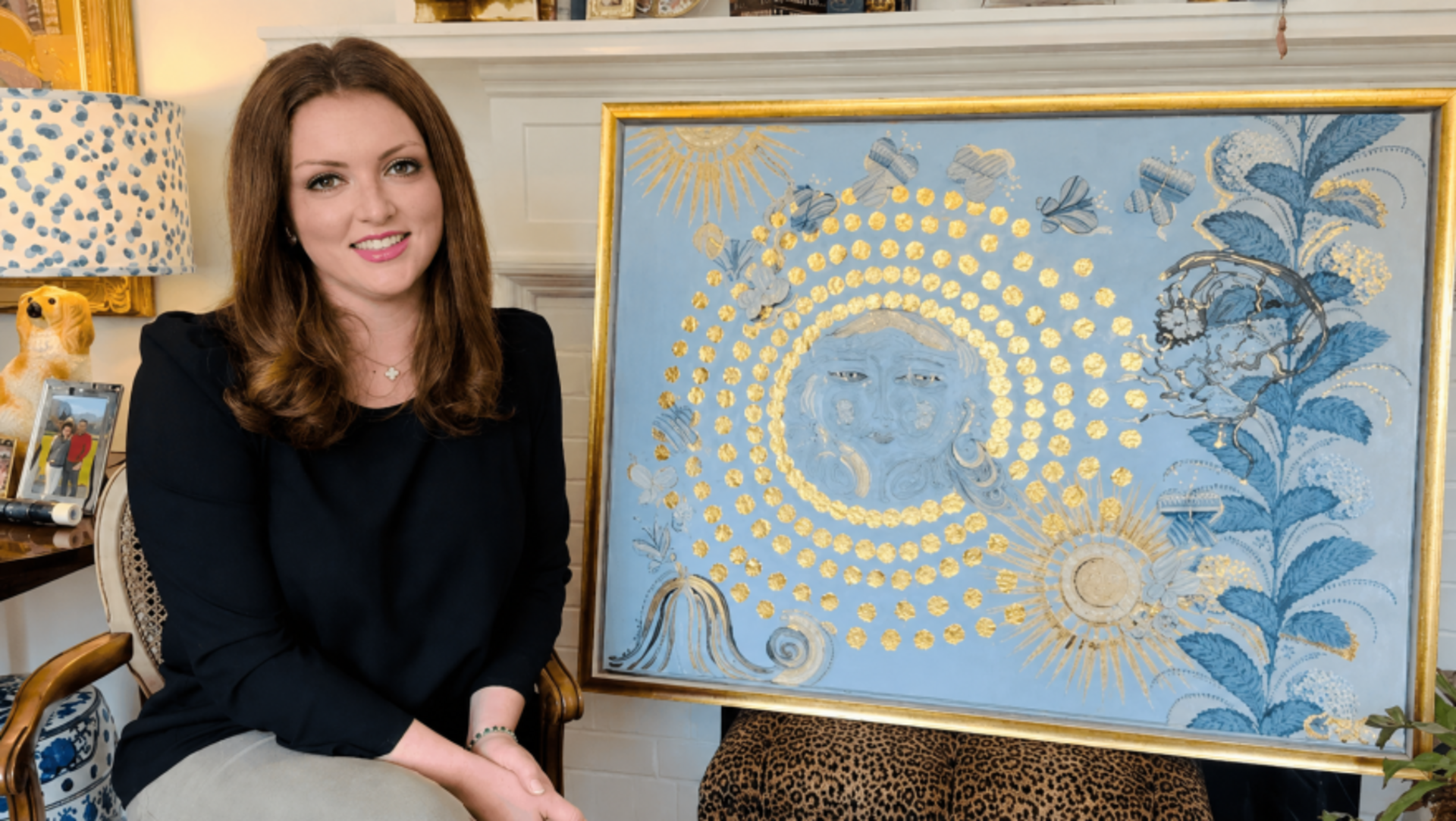
Claire Lanier's painting, Radiance, hangs in the Radiation Oncology Department at Atrium Health Wake Forest Baptist in Winston-Salem, where she completed her residency.
With brush and beam, Claire Lanier blends art, science and compassion in her care for patients.
"(Radiation oncology) felt like the right balance between technology and human connection. You get to work closely with patients at such an important moment in their lives.”
When Claire Massagee Lanier ’12 walks into a treatment room, she brings more than her medical training. She brings perspective – on illness, on inequity and on what it means to stand with someone else at a vulnerable point in their life. Claire is a radiation oncologist at Cone Health Wesley Long Hospital in Greensboro.
Despite her father being a doctor, she didn’t grow up dreaming of working alongside linear accelerators and Gamma Knives. Shortly before her first year at Guilford, Claire’s father Terry Massagee, an anesthesiologist, told her to explore all of her options. Being a physician is incredibly hard, he warned Claire when she was 18 and just starting college.
“He told me if I wasn’t 100 percent sure, don’t do it,” she says. At first, Claire listened. She imagined other paths, looking outward. But when her father suffered a heart attack a few years later, long hours in his hospital room changed everything. She hung on to every detail of his prognosis and the procedures being used to stabilize him. She realized then what she had always known but never admitted: medicine was her calling. “I wanted to be in those conversations,” she remembers. “It felt important. It felt like where I belonged.”
If her father’s heart attack gave her urgency, Guilford gave her shape. Claire grew up in Greensboro and hadn’t planned to attend a small liberal arts college close to home. “I explored the campus, met faculty and just felt like it would be a good fit,” she says. “It turned out to be perspective shifting in ways I couldn’t have predicted.”
She remembers one English class where a reading forced her to grapple with race and poverty in ways she hadn’t considered before. At first she resisted. Her father had grown up with little; his parents had limited financial means. He worked hard and overcame barriers. Didn’t that prove obstacles could be overcome with effort alone?
Over time she began to see the distinction. At Guilford she learned that marginalized groups and people of color face additional barriers her father never had to confront. Hard work matters, she says, but it is often not enough in the face of entrenched, systemic inequities.
“(Dad) might have been poor, but he was also white,” she says. “That meant he was starting on a different playing field altogether. It was a turning point for me.”
Guilford continued to challenge her perspective. As a Principled Problem Solving scholar, she worked on projects exploring Quaker values in action. For one, she placed a globe in the middle of a classroom and asked everyone to describe what they saw. Each perspective was different, partial and valid.
“It was simple but powerful,” Claire says. “We literally all had different views of the world, and they were all real.” Years later, in a cancer clinic, she would recall those lessons. Every patient arrived with a story shaped by family, hardship or gratitude. Each view mattered. Claire first learned about radiation oncology while applying to medical schools. The field intrigued her because it was deeply technical and deeply human. She loved the precision, the evolving technology and the chance to see concrete results — whether curing disease or easing pain.
“It felt like the right balance between technology and human connection,” she says. “You get to work closely with patients at such an important moment in their lives.”
She also knew the specialty was competitive. Rather than discourage her, it pushed her to dive deeper. “The more I learned, the more I fell in love with it,” she says.
Claire wrapped up her residency last summer and is now practicing independently. During that time, she learned what many doctors eventually do: medicine does not always live up to its ideals.
Time is scarce. Systems are built for efficiency, not empathy. “You go in wanting to take care of people, and then you find you’re not given the time to be the best caretaker you can be,” she says.
She also sees daily how socioeconomic status affects prognosis. Patients with fewer resources often arrive later in their disease course or face barriers that complicate treatment. “These are things we can’t fix just by treating the disease,” she says.
Through it all, her patients keep her grounded. Some arrive filled with gratitude; others with anger or fear. “And if they are angry or scared, that’s absolutely understandable,” she says.
Either way, Claire says she’s privileged to walk alongside them. “People think oncology is only sad,” she says, “but there’s also so much joy. Patients carry a perspective on life that’s inspiring.”
At home in Greensboro, Claire and her husband Patrick Lanier ’12 are raising three boys. Between work and family, she makes space for creativity.
She laughs off the label of artist, preferring to call herself “crafty.” Still, her creative streak is real. She decorates rooms, creates collages and vision boards, and finds joy in patterns and fabrics.
To mark the 25th year of the Gamma Knife at her hospital, Claire didn’t reach for statistics or plaques.
She painted. The canvas, Radiance, hangs in the Radiation Oncology Department at Atrium Health Wake Forest Baptist in Winston-Salem, where she completed her residency.
The painting carries both the weight of medical physics and the small, stubborn hopes of patients who have lain under the machine’s crown. Cranial nerves and blood vessels curve across the surface, joined by butterflies catching a suggestion of light. Transformation, fragility and strength share the canvas.
Claire dreams of designing cancer centers that feel as calming and supportive as the care delivered inside them.
“You can’t just go crazy with wallpaper and fabric,” she says. “The goal is to make people feel at peace.” She traces that philosophy back to Guilford, where she learned disciplines need not be siloed and creativity can intersect with science.
“Things are interconnected,” she says. “There isn’t just one path.”
Claire’s life today is busy, demanding and joyful. When she reflects on what sustains her — the patience to listen, the imagination to design healing spaces, the conviction that inequities must be acknowledged — she returns to Guilford. “My education there was so important,” she says. “It gave me critical thinking skills and pushed me to see perspectives I might never have considered.”