

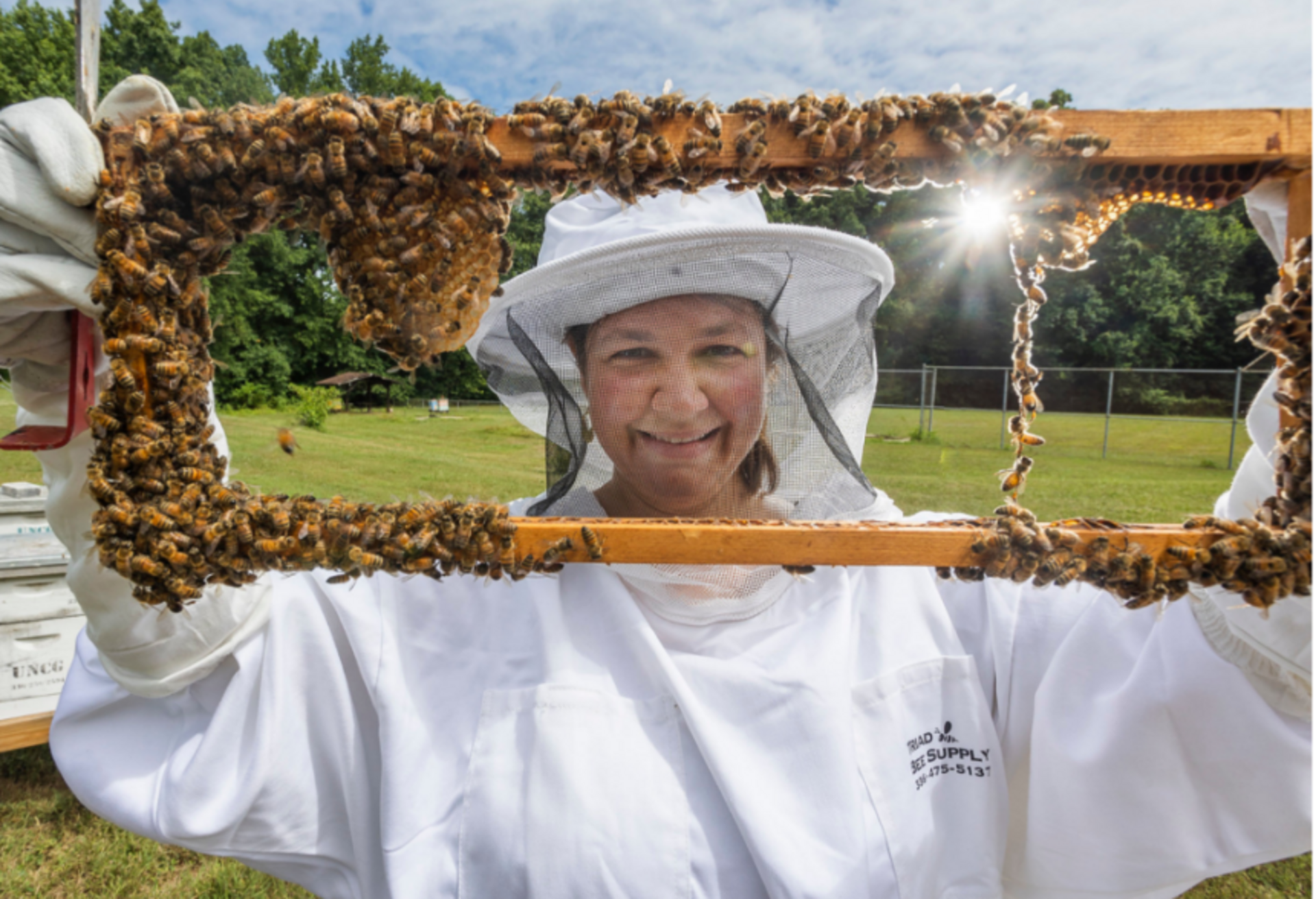
Kaira Wagoner's reserach has produced a tool to help beekeepers vulnerable colonies.
Through patience, chemistry, and a little intuition, Kaira Wagoner is giving bees – and the humans who depend on them – a fighting chance.
“I’ve always been interested in animals, from the biggest down to the tiniest – that includes insects.”
When Kaira Wagoner ’06 talks about bees, the air seems to hum. Her sentences move – dare we say? – like bees in flight.
They dart and double back, making connections that at first feel unpredictable but somehow land precisely where they should. One moment she’s explaining how compounds emitted by a sick bee can trigger an entire colony’s defense response; the next, she’s talking fondly of the childhood garden she once roamed and where she began to pay attention to the natural world around all of us. “I’ve always been interested in animals, from the biggest down to the tiniest – that includes insects,” says Kaira, who graduated from Guilford as a Biology and Health Sciences double major. “I’m doing what I love.”
That foundation – equal parts curiosity, empathy, and a refusal to accept easy answers – has carried Kaira from the Biology Department at Guilford to one of the world’s most complex creatures: the honey bee.
Today, she’s a leading researcher on honey bee behavior and health, and the founder and CEO of a company that helps beekeepers breed stronger colonies. If you’ve ever wondered how a liberal arts education can pollinate a scientific career, Kaira is your answer.
She didn’t start out chasing bees. After Guilford, she spent three years working with ceramic water filters in developing countries in Latin America and Eastern and Southern Africa. When a close friend and mentor died from malaria in West Africa, Kaira decided to return to Greensboro and begin her master’s work at UNCG studying mosquitos. After two years, she focused on bees
Kaira says she wanted her work to matter, to connect to life rather than death, and that meant turning away from the world of mosquitoes — creatures that could only ever be studied through killing. “I didn’t want to continue to always try and kill my subject matter,” she says.
So she began to look elsewhere, toward a different kind of insect — one that builds instead of destroys, one that lives for the colony. Bees, she realized, were not just fascinating but essential, the small machinery behind much of what humans eat and grow. Though most people fear the winged, golden insects with their stingers (though they rarely attack), honeybees play a pivotal role in the production of about 100 crops Americans consume. “We’ve become so reliant on bees for crop production that they really are a very important species in this country,” she says.
She earned her master’s and Ph.D. at UNCG, where, armed with her expertise in gas chromatography mass spectrometry, she started investigating the chemical communication that governs honey bee colonies.
Kaira focused on a phenomenon known as hygienic behavior, the colony’s innate ability to detect and remove sick or dying broods to protect the colony. It’s a complex process involving chemical signals, wax caps and the precise timing of intervention.
The stakes have never been higher for bees and U.S. crops. Parasites, loss of habitat, climate change and pesticides threaten to wipe out as much as 70 percent or more of the nation’s honeybee colonies this year, according to the USDA’s Agricultural Research Service. The varroa mite, a parasite that attacks and feeds on the insects, has been a major contributor to bee deaths over the years. It weakens their immune systems and spreads viruses.
The USDA believes the pests played a role in a major colony collapse 20 years ago when large numbers of bees unexpectedly disappeared. That’s where Kaira’s research comes in. She discovered that unhealthy honey bee larvae release a higher amount of certain pheromones, including those that are carrying parasites such as the varroa mite. Sensing these pheromones, adult bees remove those unhealthy bees from the colony so the colony can thrive
After her discovery of these pheromones, Kaira set out to create a practical tool for beekeepers. Her solution, UBeeO – short for Unhealthy Brood Odor – is a test that measures a colony’s hygienic response using a mixture of synthetic pheromones which mimic those emitted by stressed bees. A beekeeper applies the mixture to a small section of capped brood, waits two hours, and scores the colony’s responsiveness. A high score signals a strong, hygienic colony; a low score indicates vulnerability. It’s a way to select for disease-resistant colonies, potentially reducing the need for chemicals that, while lifesaving, can impair bee health in subtle but significant ways.
To get this technology into the hands of beekeepers, Kaira and a labmate created Optera. Through Optera, Kaira has turned that fundamental science discovery into a practical tool that beekeepers can use to manage their hives and improve colony pest and disease resistance.
“Compared to other livestock, the honey bee industry is a little behind in breeding for pest and disease resistance. ” Kaira says. “But with this finding, we thought, maybe we can turn this into a tool for beekeepers to actually measure how hygienic a colony is and then make management and breeding decisions based on those results.”
Kaira’s research isn’t just about commercial agriculture. It’s about ecosystem health. Unhealthy honey bees can transmit diseases to native bees through shared floral resources, creating a cascade of risk across pollinator populations. For Kaira, educating the public is as critical as the science itself.
She emphasizes planting pollinator-friendly flowers, especially late-season blooms, to sustain bees through the lean months, and reducing the use of chemical pesticides that threaten both honey bees and native species. Kaira’s work bridges science and public engagement. She maintains about 25 colonies at Guilford’s farm, smaller hives in her community, and dozens of colonies at UNCG’s apiaries off Spring Garden Street and at the Plant and Pollinator Center in Browns Summit, about 20 miles north of Greensboro.
Occasionally, she’ll install observation hives on her rooftop for her three boys to watch over breakfast. All of that honey has to go somewhere and a large amount finds its way into the College’s community-supported agriculture programs, connecting her research to the local food system.
Kaira also sells honey through her business, Optera, which launched the UBeeO product in January 2024. Optera, named after Hymenoptera – the scientific order including bees, ants, and wasps – serves as a bridge between research and practical application. Kaira’s website, opterabees.com, features open-access publications, instructional videos, and information about bee hygiene and pollinator health. Through it, she hopes to reach a broad audience, from backyard beekeepers to commercial operators.
The life of a bee, Kaira reminds us, is brief yet vital. Spring and summer workers live for weeks, winter bees endure months to carry the colony through cold, and queens, ideally, may live two to three years, though contemporary pressures often shorten this dramatically. Maintaining healthy colonies, she emphasizes, benefits not only honey production but also the wider web of pollinators in an area.
Her commitment to pollinator health traces back to her childhood in Charlotte, where she lived just down the street from Wing Haven, a garden and bird sanctuary. The owners of the land, her neighbors, cultivated a lush garden, gifting each other plants instead of conventional presents every year, and teaching young Kaira to feed wild birds and respect the rhythms of nature.
“I just kind of grew up loving nature,” she recalls. That love of nature guided her to Guilford College. Kaira is not Quaker, but she grew up around many Friends, who suggested she look into Guilford when she began her college search as a teen. “I fell in love with the place the first time I saw it,” she says. “The trees, the lake, the woods – all of it spoke to me.”
Kaira studied Chemistry but pivoted to Biology her junior year after a transformative semester in Kenya studying human-wildlife conflict in the Maasai Mara National Reserve. Among the Maasai denizens of lions, leopards, crocodiles and wildebeests, she discovered animal behavior, an interest that would eventually inform her approach to bees: patient observation, careful experimentation, and a focus on communication within species.
Even her personal life is intertwined with these formative spaces. She first met her future husband, Reynaldo Diaz ’06, during a chemistry lab. Nature, bees and human connection seem to follow Kaira wherever she goes – a thread running from childhood to Kenya, from Guilford to UNCG. For Kaira, research is never purely academic.
It is applied, ethical and forward-thinking. By decoding the chemical cues that signal stress in bees, she is helping beekeepers breed resilient colonies, reduce chemical exposure, and protect native pollinators. By opening her labs and fields to the public, she is fostering awareness of the invisible work that underpins ecosystems and food systems alike
And by running a business dedicated to translating science into practical tools, she ensures that the benefits of her research reach far beyond the ivory tower. “Bees are absolutely fascinating,” she says, her voice tinged with wonder. “The more I work with them, the less I feel like I know, which is incredibly inspiring as a scientist.”