

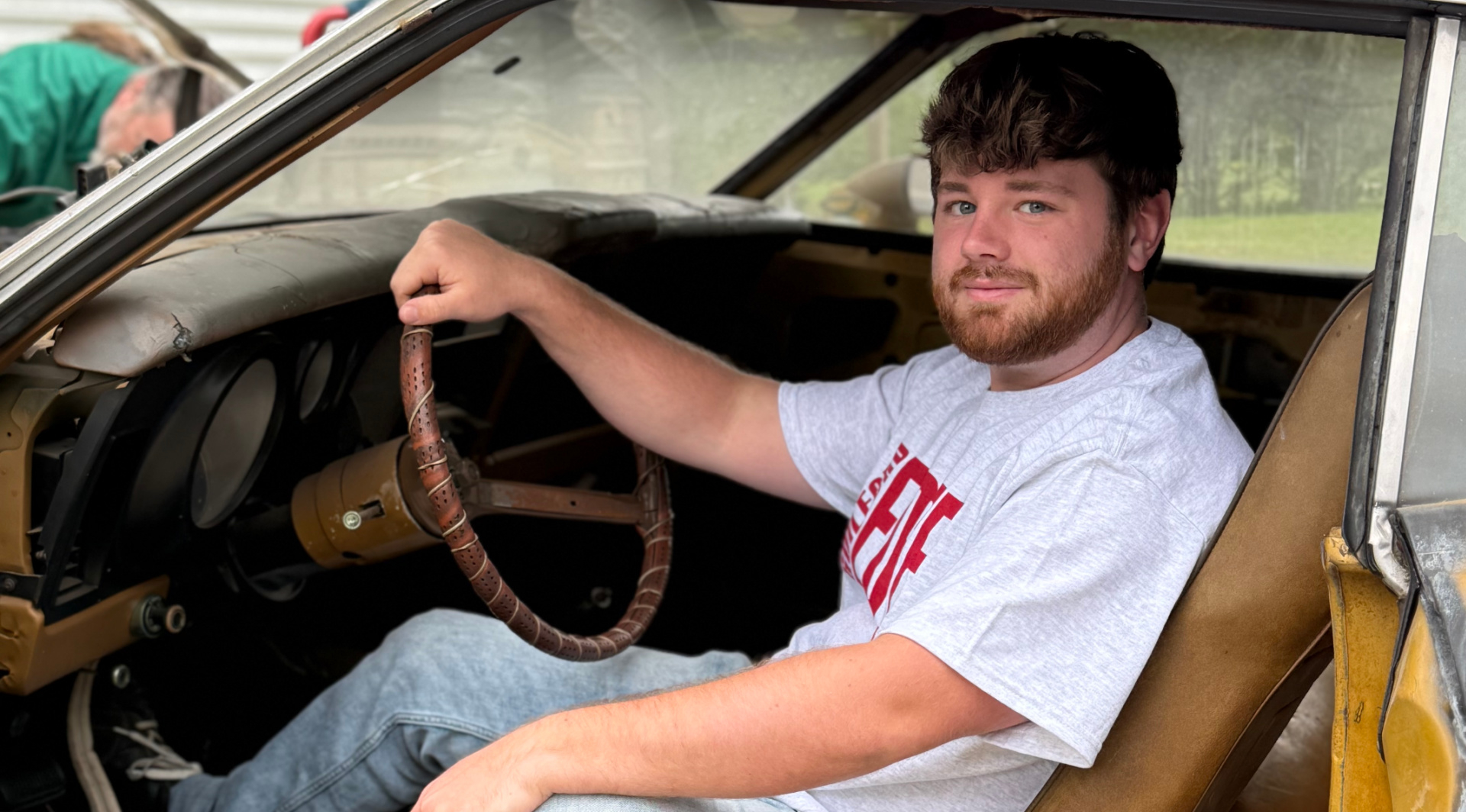
Whether in the lab or under the hood of a car, Biology major Chris Anderson '26 is driven by patience, precision and the pursuit of better outcomes.
“I want to be behind the research. The person coming up with new ideas that can help patients.”
Chris Anderson ’26 likes figuring out how things work.
That curiosity showed up in the labs at Guilford, where he studied Biology, and in the family garage back home in Mocksville, N.C., where he and his father are, piece by piece, rebuilding a 1972 Mustang. To Chris, the connection is obvious: both are about untangling complicated issues, understanding systems and having the patience to see something complicated come together over time.
“I like solving problems,” Chris says. “With the car, you’re welding, patching things, fixing what’s broken. In biotechnology, you’re doing the same thing only for people.”
It’s that overlap – between hands-on tinkering and scientific inquiry – that has defined his time at Guilford and will shape what comes next.
Chris, who graduated May 9 with a double major in Biology and German, didn’t arrive on campus with a perfectly mapped-out plan. Like so many Guilfordians before him, he came because there was something about this place that felt right.
A brochure in the mail piqued his curiosity. A tour of the campus and its students convinced him he was home. “Obviously it’s a beautiful setting but more than that, I liked the community,” he says. “There was just something about it that told me I’d found a home.”
He remembers as a high school senior walking up to students and introducing himself, asking questions, kicking the tires to a place he would call home over the next four years.
“They were just really down-to-earth people who were willing to talk to me, even though I wasn’t a student yet,” he says. “That’s what stood out. The students knew they might never see me again, but they treated me like I’d always been here. That’s Guilford – people here will go out of their way for you.”
Meet more members of Guilford's Class of 2026
That sense of connection carried into the classroom, where he quickly built relationships with faculty who helped him refine his interests. He began on a more traditional medical track but realized it wasn’t the right fit.
“It was a lot of schooling and not the work-life balance I wanted,” he says. “My professors really took the time to understand what I was interested in and helped guide me.”
He credits Biology professors Michele Malotky and Christine Stracey with helping him narrow a wide range of interests – from marine biology to environmental science – into a clearer focus on biomedical technology.
“I want to be behind the research,” he says. “The person coming up with new ideas that can help patients.”
He’ll get that chance as he starts work at a Winston-Salem biotechnology company developing therapies for chronic kidney disease. The work position puts him exactly where he wants to be: inside a field where progress doesn’t happen overnight, but persistence pays off.
That mindset has been reinforced every time he steps into the garage at home, where he and his dad are restoring the Mustang.
He paid about $2,500 for it – a fraction of its potential value – and took on the long, sometimes frustrating process of bringing it back to life. So far, that’s meant cutting and welding body panels, treating rust, stripping old coatings and pulling the engine.
“It’s not going to happen overnight,” he says. “You’re going to get frustrated. You’re going to hit roadblocks.”
The same, he says, is true of a career in science – or life in general.
“If you keep doing something every day, even small things, it adds up,” he says. “You just try to make something a little better than it was the day before. That’s my plan for after (Guilford). Learn something new, keep building.”