

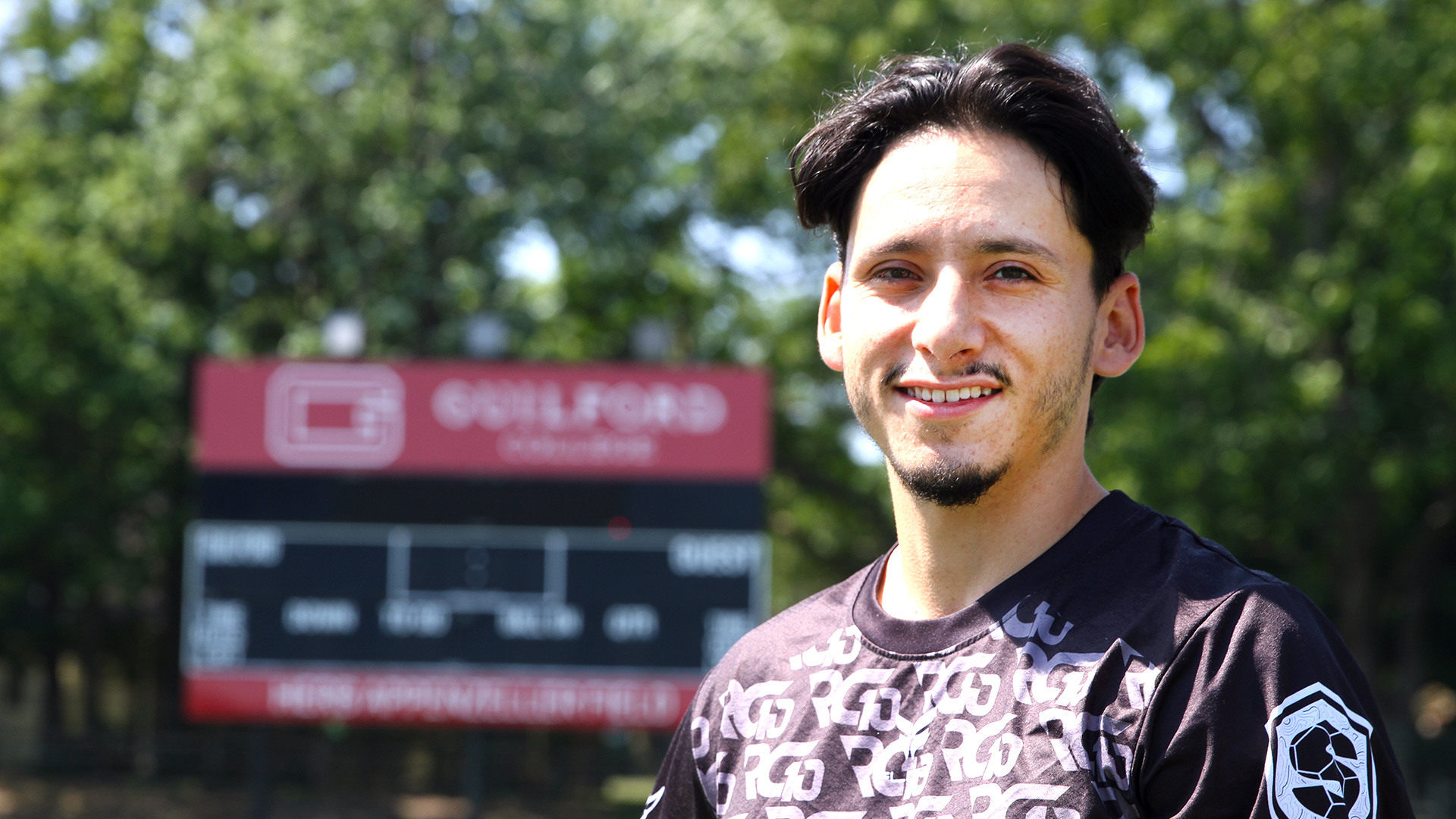
Economics graduate Rodrigo Gudino ’22 is creating a different path in soccer by building a player-development academy that is shaping the next generation of athletes across the Triad.
“The funny thing is, I always thought I’d get attention by becoming a professional player. But I gained more influence when I stopped being one.”
Across the globe, millions of soccer fans are watching the world’s greatest players chase a championship, a legacy and a place in the sport’s history. World Cup stadiums have been packed for the past month. The cameras are now aimed at Sunday’s final. The dreams that began with kids kicking a ball in empty fields are suddenly on the world’s biggest stage.
Rodrigo Gudino ’22 knows that dream well.
When he arrived at Guilford College, he imagined his future in soccer the way thousands of young players do: wearing a professional jersey, playing before packed stadiums and making the sport he loved his career.
That dream didn’t disappear. It simply changed.
Today, Rodrigo, who graduated with a degree in Economics, is one of the Triad’s emerging soccer entrepreneurs, building RG10 Football, a player-development business that is attracting young athletes from across the region.
This summer, he also led a community effort to raise $50,000 so his club could compete in The Soccer Tournament – known throughout the soccer world as TST – an internationally recognized 7-on-7 competition in Cary, N.C., that draws professional players, former stars and teams from around the world.
For Rodrigo, the journey from aspiring professional player to business owner began with an unexpected lesson at Guilford.
“I realized I could still make an impact in soccer,” he says. “It just wasn’t going to be the way I originally imagined.”
That realization wasn’t easy.
Like many college athletes, Rodrigo spent years chasing the next level, believing every training session and every match moved him closer to a professional contract. He played professionally in Chicago, Richmond, Virginia and Mexico in smaller leagues.
Eventually, he recognized that while his playing career might have limits, his ability to help other players did not.
Instead of seeing that as failure, he treated it as an opportunity.
After returning to Greensboro in 2022, Rodrigo began working with young players individually, focusing on technical development, confidence and decision-making. Word spread. Families recommended him to friends. One player became five. Five became 20.
Today, RG10 serves players ranging from beginners to elite prospects, emphasizing long-term development over wins and trophies.
“The player has to come first,” Rodrigo says.
That philosophy has become the foundation of RG10 — his initials and jersey number — and it reflects lessons he learned at Guilford.
As an Economics major, Rodrigo studied markets, incentives and entrepreneurship. Those classes helped him think beyond simply coaching players and toward building a sustainable organization with a clear mission and a model for growth.
His liberal arts education also shaped how he approached leadership. Running a business means solving problems every day: communicating with parents, managing finances, hiring coaches, marketing programs and creating experiences families trust.
Those are challenges few athletes imagine when they dream about playing professionally.
They are challenges Rodrigo now embraces.
His biggest undertaking came when RG10 earned acceptance into TST, one of the most competitive small-sided soccer tournaments in the world. Participation required raising $50,000 in entry fees and expenses — a daunting figure for a young organization.
Rather than back away, Rodrigo rallied supporters around a larger vision.
The fundraising campaign wasn’t just about entering a tournament. It was about showcasing Greensboro soccer on an international stage and proving a community could invest in a different model of player development.
He raised the money.
Although RG10 did not advance beyond the first round, Rodrigo left the tournament more determined than ever. The experience showed him what the organization could become: not just a training program, but a place where players grow, compete and discover what the game can teach them.
These days, Rodrigo doesn’t measure success by the professional contract he never signed.
He measures it by the players who return excited to improve, the parents who tell him their children have rediscovered confidence and the growing community that believes development matters more than shortcuts.
He didn’t make it to the world’s biggest stage as a player.
Instead, he’s building a stage for others — helping the next generation of athletes chase the dream he once carried himself.
“The funny thing is,” he says, “I always thought I’d get attention by becoming a professional player. But I gained more influence when I stopped being one.”