Academic Program

Guilford stresses breadth and rigor in its academic program. As a Quaker-founded college, it offers an educational experience that emphasizes the study of human values and the inter-relatedness of the world’s knowledge and cultures.
The Five Academic Principles
These principles govern all courses and other educational experiences at the College:
Innovative, student-centered learning
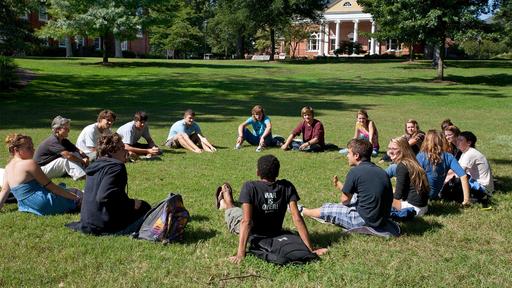
Guilford embraces effective and adventurous pedagogy. Learning formats are chosen to promote dynamic exchange among students and between students and faculty.
Throughout, Guilford places the individual student at the core of its educational mission. In an environment committed to the value of interdependence, each student is encouraged to develop an individual viewpoint through the sharing of ideas with other members of the College’s intentionally diverse community.
Challenge to engage in creative and critical thinking
Guilford emphasizes these activities: identifying and solving problems; delving below the surface of things to understand phenomena in their complexity; considering how frameworks and perspectives affect observations and analyses; appreciating the interplay of believing and doubting; and combining intuition, imagination, and the aesthetic sense with reasoning, quantitative analyses, and factual knowledge.
Students learn not only to develop and synthesize ideas but also to articulate them clearly via the spoken and written word and other forms of creative expression. In particular, Guilford emphasizes writing as a mode of both learning and communicating, and thus students write intensively throughout their years here. Guilford especially values courses that connect different ways of knowing: hence the College’s interdisciplinary emphasis.
Cultural and global perspectives
Guilford strives to prepare students to be citizens of the world. Thus the curriculum is designed to encourage students and faculty to respect and learn from people of other cultures and also to foster an understanding of ecological relationships within the natural environment. By interacting with people from different cultures and gaining sensitivity to other ways of life, students deepen their academic investigation of Western and other traditions. In the process, students are challenged to envision better societies and to work collectively with others toward mutual benefit.
Values and the ethical dimension of knowledge
The Quaker ethos deeply influences the academic program as it does all other aspects of college life. In particular, the curriculum nurtures the spiritual dimension of wonder, the pursuit of meaning in life, and sensitivity to the sacred. It also promotes consciousness of those values necessary to successful inquiry: honesty, simplicity, equality, tolerance.
The College’s courses explore the ethical dimension of knowledge. This often requires close attention to such issues as gender, race, ethnicity, religion, social justice, and socioeconomics in historical and contemporary contexts.
Focus on practical application: vocation and service to the larger community
Noting Quaker founder George Fox’s call for schools to teach “things civil and useful,” Guilford’s teachers help their students choose majors and sequences of supporting courses that fit their interests and aptitudes and lead to work and service possibilities that will bring personal fulfillment and challenge. The College also upholds each individual’s obligation to the larger community: thus its commitment to personal responsibility, social justice, world peace, service, and ethical behavior. Rooted in the Society of Friends’ social testimonies, the College aims to help its graduates learn to evaluate the effects of their actions and the implications of their decisions.
Strategic Outcomes
We aim to graduate students who are “ready on day one” to contribute to their communities and to succeed at work, graduate or professional school, community service, and life in general. Strategic outcomes for students fall into four broad areas:
- cognitive (think critically, know globally)
- skills (communicate effectively, create insightfully)
- values (engage responsibly, choose diversity)
- applications (ability to learn experientially, achieve personal and career goals)
These areas help students to master the general education and disciplinary components of the curriculum. Whether an aspiring artist or chemist, students need to think critically, communicate effectively, engage responsibly, and learn experientially, among other things. All these attributes define the liberal education of a Guilford College graduate.
The Curriculum
The curriculum consists of five tiers:
Foundations
Throughout their time at Guilford, students develop skill competencies in the following specific areas: writing, oral communication, research, information technology and quantitative reasoning. The platform for these competencies occurs generally in the Foundations courses; students then continue to develop these competencies during their course of studies.
The five Foundations requirements are: The First Year Experience or Adult Transitions, College Reading and Writing: Many Voices, Historical Perspectives, Foreign Language, and Quantitative Literacy. These requirements provide solid grounding in Guilford’s five academic principles.
Explorations
Breadth: To gain educational experiences in each of the five disciplinary divisions (arts, business and policy studies, humanities, natural sciences, and mathematics and social science), students are required to take one “Breadth” course in each of these divisions.
Critical Perspectives: The Critical Perspectives courses speak directly to Guilford’s core values. Each student must complete three specially designated “Critical Perspectives” courses: Intercultural, Social Justice/Environmental Responsibility, and Diversity in the U.S.
Interdisciplinary Studies (IDS) Capstone
After students reach senior standing they must take an (IDS) capstone course. The IDS course allows students to draw upon knowledge and skills gained from previous College work and explore issues that cross traditional disciplinary lines.